Last month I had a free couple of days and decided to spend them hiking with Kent, Spencer and Erik. We decided to go through the Ashdown Gorge Wilderness (Kent's suggestion) just a few miles east of Cedar City in Utah's red rock country. More than anything I was anticipating just getting away and seeing Cedar Breaks National Monument from the west side. I wasn't even thinking of scenic upland meadows when, after a couple of hours hiking we came into a clearing called Stud Flat.
After all, who would think that a place with such a name would be scenic? I was pleasantly surprised. Rising above the meadow are red rock formations with pine and fir forests all around. We decided that we would spend the night right there even though we weren't all that tired. We just couldn't bring ourselves to leave the place.
Just the week before I had driven through Yosemite's famous Tuolumne Meadows - also a high elevation meadow. It is famous as one of the gems of our (perhaps) most celebrated national park. And yet I can say that it isn't any more beautiful than Stud Flat in the spring. Here's a picture of a pair of large marbles (Euchloe ausonides) that I noticed near the meadow. I guess I should also mention how impressive the gorge is. We spent the following day hiking through its winding canyons. It may be a while before I do the gorge hike again though. But I can say with confidence that I will be back to see Stud Flat sooner than later.
Sunday, July 6, 2014
Sunday, June 22, 2014
Extra-terrestrial Sheep
Last week I found myself driving down a lonely Nevada highway listening to a boring audio book (by Sigmund Freud) when my eye wandered to a bright white mineral heap by the side of the road. As I looked closer I discovered that there were over a dozen bighorn sheep resting on top of it idly chewing their respective cuds.
I came to a belated stop, turned the truck around and pulled off the road to have a closer look. Surprisingly they didn't seem to be all that troubled by my presence. I wondered if perhaps they had been accustomed to stop at this place for water or some other human hand-out.
As I got closer still, they did become a little agitated and I heard a few half grunts and half bleats from the ewes and watched as adolescent rams came into line. They were all quite beautiful with their brown and white contrasting colors and a couple of the rams were old enough to have sizeable horns.
When I got back in my truck I realized that I was at the western end of the somewhat famous Extra-terrestrial Highway (ending at the Warm Springs crossroads) where the sheep were resting. Who knows, maybe they were quite used to the scenery and were just waiting for the show to start.
I came to a belated stop, turned the truck around and pulled off the road to have a closer look. Surprisingly they didn't seem to be all that troubled by my presence. I wondered if perhaps they had been accustomed to stop at this place for water or some other human hand-out.
As I got closer still, they did become a little agitated and I heard a few half grunts and half bleats from the ewes and watched as adolescent rams came into line. They were all quite beautiful with their brown and white contrasting colors and a couple of the rams were old enough to have sizeable horns.
When I got back in my truck I realized that I was at the western end of the somewhat famous Extra-terrestrial Highway (ending at the Warm Springs crossroads) where the sheep were resting. Who knows, maybe they were quite used to the scenery and were just waiting for the show to start.
Sunday, May 18, 2014
Hoplia Beetles on Western Azalea
One of California's truly spectacular flowers is the western azalea. Every time I see this plant in bloom - with its large showy white flowers - I have to remind myself that this is not an escaped houseplant.
I came across a couple of these very beautiful bushes this last week near Big Creek (a few miles north of Pine Flat Reservoir) in Fresno County. On one of the plants I discovered dozens of Hoplia beetles. These are scarabs with only a single claw on each foot (tarsus) that are ideal for hanging onto plants.
Fortunately for the azaleas, the beetles liked to aggregate around only a few flowers while feeding. I wonder if they taste as good as they look?
I came across a couple of these very beautiful bushes this last week near Big Creek (a few miles north of Pine Flat Reservoir) in Fresno County. On one of the plants I discovered dozens of Hoplia beetles. These are scarabs with only a single claw on each foot (tarsus) that are ideal for hanging onto plants.
Fortunately for the azaleas, the beetles liked to aggregate around only a few flowers while feeding. I wonder if they taste as good as they look?
Monday, March 31, 2014
Panama Bird List
Following is a list of bird species seen in Panama during the second week of March, 2014 – by Steve Bonta, Jon Quist and myself. We started the week along Pipeline Road near the Panama Canal, worked our way west and up into the area around El Valle, then drove over to Bocas del Toro and finally back to ChitrĂ© to end the week.
Magnificent Frigatebird, Sandwich Tern, Laughing Gull, Herring Gull, Neotropic Cormorant, Brown Pelican,
Ruddy Ground Dove, Tropical Kingbird, Turkey Vulture, Black Vulture, Great Tailed Grackle, Yellow-headed Caracara, Rock Pigeon, Spotted Sandpiper, Fork-tailed Flycatcher, Yellow-rumped Cacique, Plain Xenops, Song Wren, Cattle Egret, Great Egret, Golden-collared Manakin, Red-crowned Woodpecker, Crimson-backed Tanager, Black-chested Jay, Blue Cotinga, Louisiana Waterthrush, rufous-capped Warbler, Scarlet-rumped Tanager, Common Bush Tanager, Savannah Hawk, Crested Caracara, American Kestrel, Great Black Hawk, Anhinga, Wood Stork, Red-breasted Blackbird, Crested Oropendola, Green Ibis, Southern Lapwing (third picture), Northern Jacana, Purple Gallinule, Great Kiskadee, Swallow-tailed Kite, Pale-vented pigeon, Slate-colored Seedeater, Blue-black grassquit, Spectacled Antpitta, Smooth-billed Ani, Amazon Kingfisher, White-tailed Kite, Yellow-crowned Night Heron, Tricolored Heron (first picture), Snowy Egret, Keel-billed Toucan, Common Tody Flycatcher, Masked Tityra, Little Blue Heron (second picture), White-shouldered Tanager, Osprey, Montezuma Oropendola, Large-billed Tern, Yellow-rumped Warbler, Prothonotary warbler, Semipalmated Plover, Willet, Whimbrel, White Ibis, Buff-breasted sandpiper, Straight-billed Woodcreeper, Clay-colored Thrush, Red Knot, Black-necked Stilt, Plain-breasted Ground Dove
Magnificent Frigatebird, Sandwich Tern, Laughing Gull, Herring Gull, Neotropic Cormorant, Brown Pelican,
Ruddy Ground Dove, Tropical Kingbird, Turkey Vulture, Black Vulture, Great Tailed Grackle, Yellow-headed Caracara, Rock Pigeon, Spotted Sandpiper, Fork-tailed Flycatcher, Yellow-rumped Cacique, Plain Xenops, Song Wren, Cattle Egret, Great Egret, Golden-collared Manakin, Red-crowned Woodpecker, Crimson-backed Tanager, Black-chested Jay, Blue Cotinga, Louisiana Waterthrush, rufous-capped Warbler, Scarlet-rumped Tanager, Common Bush Tanager, Savannah Hawk, Crested Caracara, American Kestrel, Great Black Hawk, Anhinga, Wood Stork, Red-breasted Blackbird, Crested Oropendola, Green Ibis, Southern Lapwing (third picture), Northern Jacana, Purple Gallinule, Great Kiskadee, Swallow-tailed Kite, Pale-vented pigeon, Slate-colored Seedeater, Blue-black grassquit, Spectacled Antpitta, Smooth-billed Ani, Amazon Kingfisher, White-tailed Kite, Yellow-crowned Night Heron, Tricolored Heron (first picture), Snowy Egret, Keel-billed Toucan, Common Tody Flycatcher, Masked Tityra, Little Blue Heron (second picture), White-shouldered Tanager, Osprey, Montezuma Oropendola, Large-billed Tern, Yellow-rumped Warbler, Prothonotary warbler, Semipalmated Plover, Willet, Whimbrel, White Ibis, Buff-breasted sandpiper, Straight-billed Woodcreeper, Clay-colored Thrush, Red Knot, Black-necked Stilt, Plain-breasted Ground Dove
Wednesday, January 22, 2014
December Birds at Joshua Tree National Park
Last month I took a side trip through Southern California's Joshua Tree National Park. December is an odd time of the year to make such a trip. There are very few plants blooming and much of the wildlife is hunkering down. But I had the time so I took the trip anyway.
The above picture is of the uneaten berries. The picture below is of the digested ones on a wildlife marker. I sort of got the idea that phainopeplas don't like rabbits.
I was in for a bit of a surprise when I stopped behind the northeast Visitors Center where there is a desert oasis of sorts. Flitting around in the palms was a bold cactus wren, that didn't seem to be bothered by me at all.
The ranger in the gift shop suggested that I walk along the path and check out the phainopeplas that were feeding on the mistletoe berries.
Sunday, November 3, 2013
Tired November Butterflies
It's now the beginning of November and still the rains have not come to Fresno with any sort of confidence. Our days are very pleasant in the 70's and the nights hardly get into the 40's. This is not unusual. Very often the first rains don't come until around Thanksgiving time, or even later. What this means for many of the late summer and fall insects is that they continue their lives without finding a place to over-winter, or of succumbing to the elements. They linger and they get worn out by their long lives.
Here is a gray hairstreak (Strymon melinus) that Kathy and I ran into along the path by Cottonwood Park yesterday while we were out enjoying the warm weather. It has lost much of its delicate wing "tail" and many of its cloudy gray scales - still a beautiful butterfly but clearly tired out.
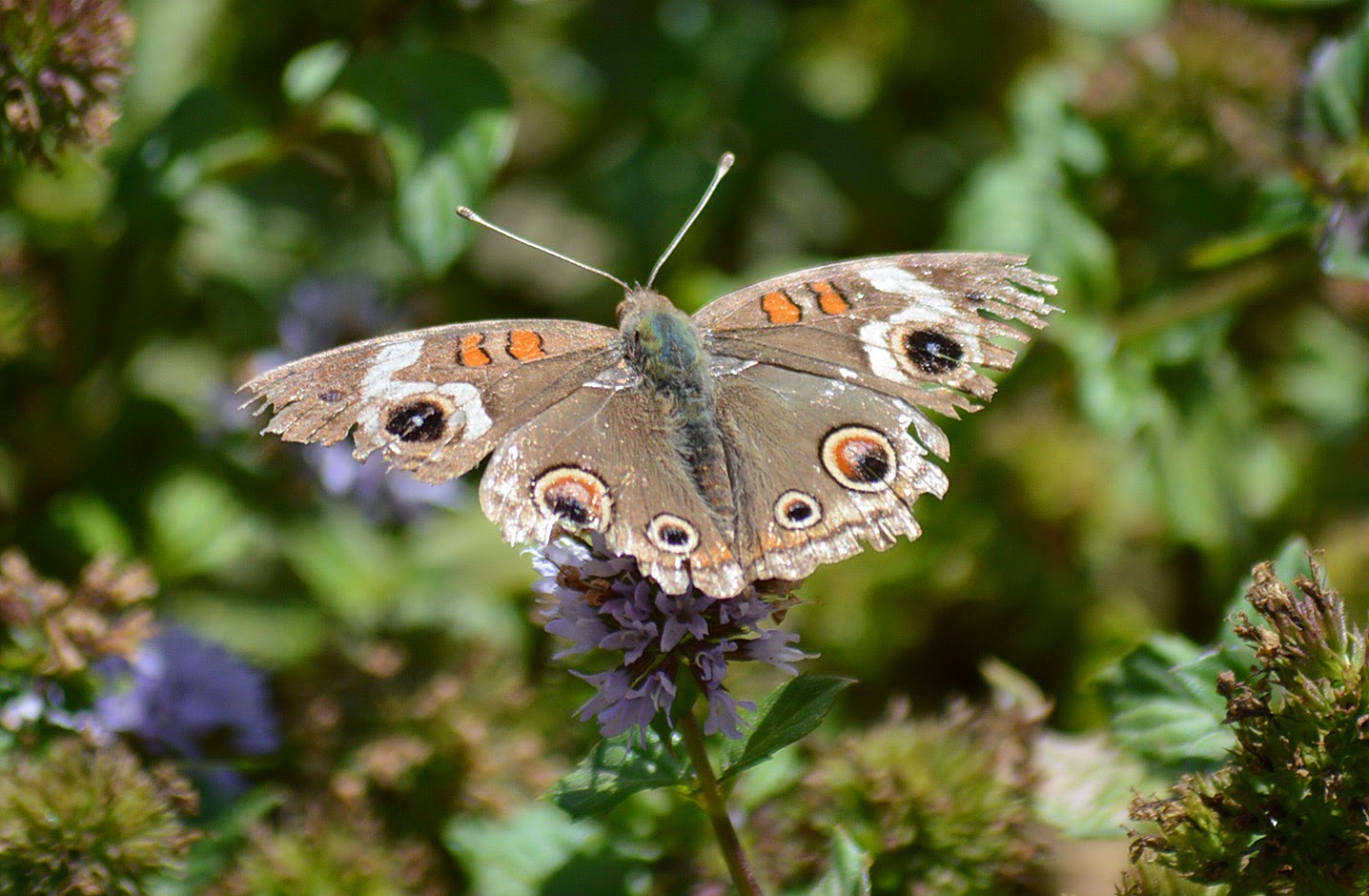
The common buckeye (Junonia coenia) was also out along the narrow stream bank in the patches of flowering mint. I was amazed that such a worn-out creature could still fly.
There is also a catchment basin by the park with a gathering of waterfowl. A snowy egret (Egretta thula) was kind enough to fly close enough for a picture. I was impressed by the striking yellow markings on the face and legs when seen up close.
Here is a gray hairstreak (Strymon melinus) that Kathy and I ran into along the path by Cottonwood Park yesterday while we were out enjoying the warm weather. It has lost much of its delicate wing "tail" and many of its cloudy gray scales - still a beautiful butterfly but clearly tired out.
The common buckeye (Junonia coenia) was also out along the narrow stream bank in the patches of flowering mint. I was amazed that such a worn-out creature could still fly.
There is also a catchment basin by the park with a gathering of waterfowl. A snowy egret (Egretta thula) was kind enough to fly close enough for a picture. I was impressed by the striking yellow markings on the face and legs when seen up close.
Saturday, October 12, 2013
Bagrada Bug in Fresno
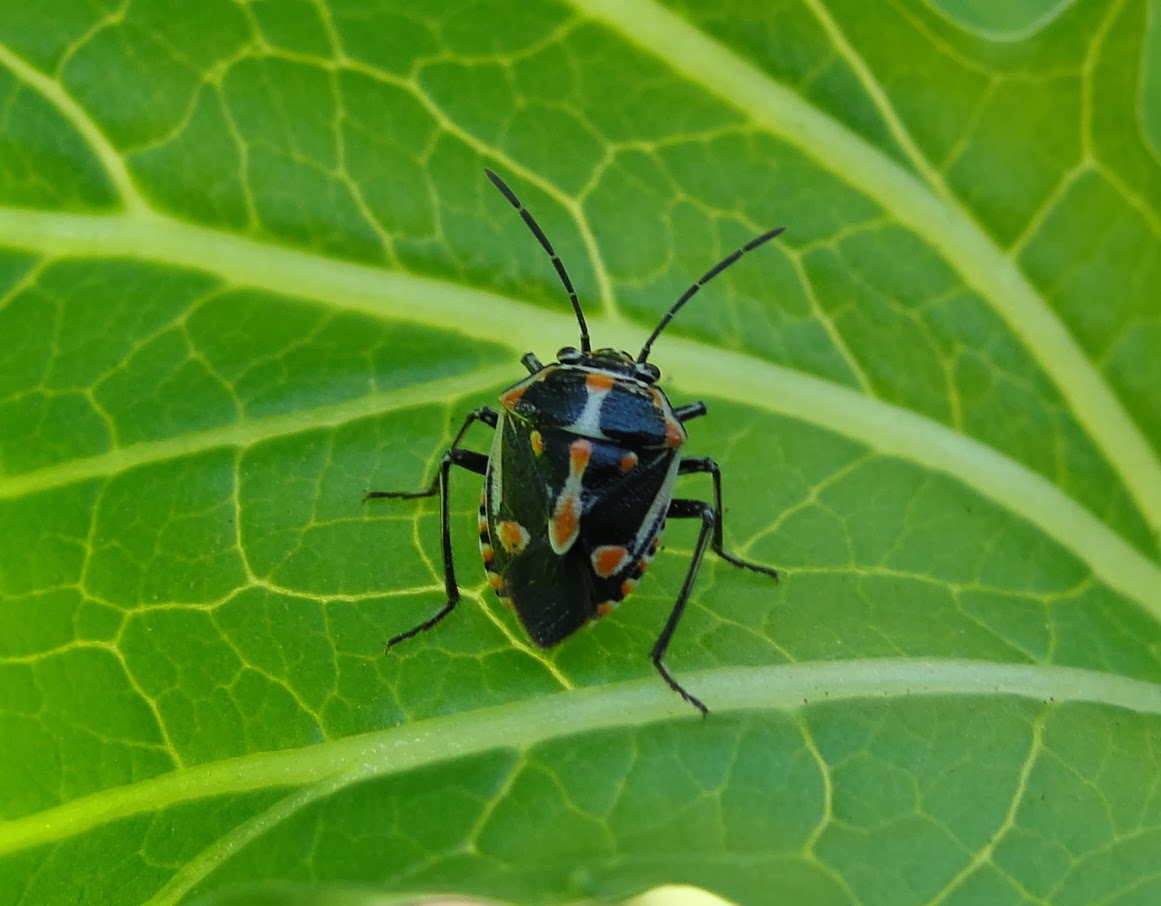
The bagrada bug (Bagrada hilaris) has finally made it to Fresno. Michael Yang announced last week that he found it among Hmong farms in Fresno County. Two days ago, I found it in Fresno proper - on my own mizuna lettuce plants no less.
The large bug is the female and the smaller one (pictured twice) is the male. They are only about the size of a plant bug - maybe a bit bigger - but quite a bit smaller than other stink bugs (of the family Pentatomidae) which the bagrada bug is a member of.
I have a pretty small garden in the middle of suburban Fresno and it must have been a very lucky pair of bugs that found my lettuce plants. That, or maybe mizuna lettuce is just irresistible to the critters. You have to admit, they're pretty colorful.
The large bug is the female and the smaller one (pictured twice) is the male. They are only about the size of a plant bug - maybe a bit bigger - but quite a bit smaller than other stink bugs (of the family Pentatomidae) which the bagrada bug is a member of.
I have a pretty small garden in the middle of suburban Fresno and it must have been a very lucky pair of bugs that found my lettuce plants. That, or maybe mizuna lettuce is just irresistible to the critters. You have to admit, they're pretty colorful.
Sunday, September 22, 2013
Oso Flaco Lake
Earlier this month while traveling in San Luis Obispo County (along coastal California) I noticed an interesting state park with ample coastal dune habitat. I decided to stop and have a look.
I'm glad I did, it was a beautiful day (as most summer days are along the coast) and the lake was alive with waterfowl. A nice boardwalk bridge extends from the main path over the lake and a well-maintained trail continues on to the beach through rich coastal dune habitat.
I came across this Boisduval's blue (Icaricia icarioides) feeding on California aster (Lessingia filaginifolia) and a little further along I was able to catch a picture of a California thrasher
With a beautiful yellow ice-plant (the marigold ice-plant, Conicosia pugioniformis) in bloom nearby.
On the way back I caught a young phalarope swimming in the lake.
I'm glad I did, it was a beautiful day (as most summer days are along the coast) and the lake was alive with waterfowl. A nice boardwalk bridge extends from the main path over the lake and a well-maintained trail continues on to the beach through rich coastal dune habitat.
I came across this Boisduval's blue (Icaricia icarioides) feeding on California aster (Lessingia filaginifolia) and a little further along I was able to catch a picture of a California thrasher
With a beautiful yellow ice-plant (the marigold ice-plant, Conicosia pugioniformis) in bloom nearby.
On the way back I caught a young phalarope swimming in the lake.
Sunday, July 28, 2013
Alpine Butterflies near Disappointment Lake
Earlier this month a handful of us from Fresno took a 35 mile hike just east of Courtright Reservoir (in Fresno County) in the Sierra Nevada of California. Along the way we saw several beautiful butterflies – some of which I was lucky enough to get pictures of.
Further up the trail toward Disappointment Lake (the name of which is a clear misnomer) I found one of the butterflies in the arctic blue complex (Agriades franklinii) feeding on Western bistort (Polygonum bistortoides).
These first two pictures are at Post Coral Creek where this lovely greenish blue (Plebejus saepiolus) was enjoying the sun and white daisy.
Further up the trail toward Disappointment Lake (the name of which is a clear misnomer) I found one of the butterflies in the arctic blue complex (Agriades franklinii) feeding on Western bistort (Polygonum bistortoides).
And then even further up the trail (actually on boulders where there was no trail) just below the LeConte Divide we spotted a handful of checkerspots (in the Edith’s checkerspot complex – Occidryas editha). This is an amzing place for butterflies – at 11,000 feet on a windswept ridge where trees don’t even grow. What a beautiful place.
Sunday, June 23, 2013
Butterflies on Desert Catalpa
Last month, Jon and I took a detour on a dirt
road several miles SE of Baker, California. It lead to a dry wash filled with desert catalpa (Chilopsis linearis) in full bloom.
We found sphecid wasps (one just visible in the upper right corner in the picture above), a few species of bees and several butterflies all competing with each other in a feeding frenzy. The sleepy
oranges (Eurema nicippe) disregarded
any sense of caution and plunged much of their bodies inside to get at the
nectar (making it easy to snap pictures).
The lovely great purple hairstreak (Atlides halesus) with metallic blue and
red scales was a bit more wary.
Sunday, May 26, 2013
Kelso Dunes In Mid May
Earlier this month we took a detour to check out the Kelso Dunes (SE of Baker, California).
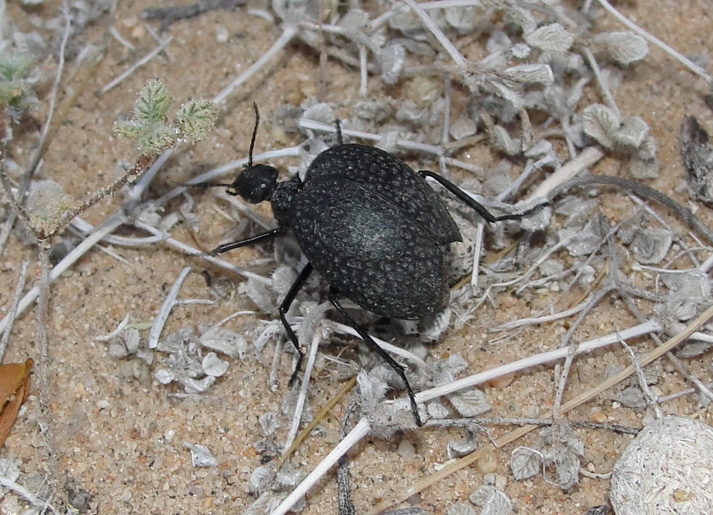
We got there as the sun was going down and found several interesting insects. Jon spotted this impressive blister beetle (Cysteodemus armatus) walking around in the sand among the vegetation along with several other beetles.
I was a bit surprised to find a June beetle feeding (and probably pollinating?) a primrose. I’ve never seen this before. Here's a shot of a Western banded gecko (Coleonyx variegatus) that we found out hunting as soon as the stars came out. It's a bit blanched from the flash.
It was a fun evening (although I did get stung in the lip by a tiphiid wasp). In the morning as we were driving away, we spotted a kit fox pup (Vulpes macrotis - the "big-eared fox") emerging from its den to enjoy the early sun. It sure was a cute thing.
Sunday, April 28, 2013
Black-Chinned Hummingbird at Arroyo Seco
Late April is a great time to visit Arroyo Seco in Monterey, County, California (just a few miles west of Greenfield). There is a dirt road that winds up past the parking area but this is gated and you have to walk in to enjoy the canyon and the pretty emerald green stream that runs at the bottom.
The hills here are covered in wildflowers. And for me the most impressive were the many pale orange monkey flowers.
I watched several carpenter bees try and get at the nectar from the outside with their strong mandibles without success. Apparently the long flowers are too difficult for them to enter otherwise.
I also noticed several black-chinned hummingbirds flying about - and managed to catch this one juvenile on film feeding from a horse-mint flower.
I snapped a shot of the adult male the following morning not far from the trail (road) head.
Tuesday, April 2, 2013
Kodiosoma fulvum
Here's a fascinating tiger moth that Jon, Michael and I found last week along the Merced River just south of Yosemite (in California). I didn't realize that it was a tiger moth at first. Jon snagged it in his net thinking it was an unusual bee - yes it was flying in the middle of the day. This is obviously not typical tiger moth behavior.
According to Powell and Opler (in Moths of Western North America) this small species (not much more than a centimeter long) has various color forms. It is also fairly uncommon. I have to admit that I have never seen a day-flying arctiid before - and certainly not in the month of March. It was a fun find.
Saturday, February 23, 2013
Central American Squirrel Monkey
The Central American squirrel monkey (Saimiri oerstedii) is designated a vulnerable New World monkey. It doesn't seem to be so uncommon in the places it lives. It's just that there aren't many places where it does, actually, live.
Steve, Michael and I ran into a small machination of the monkeys on the Osa Peninsula in Costa Rica a couple of years ago. They were jumping through the trees right along the single dirt road that winds through the peninsula.
The monkey-crossing sign was actually photographed at the Wilson botanical area closer to the Panamanian border. You have to love a place that troubles itself about such things.
Steve, Michael and I ran into a small machination of the monkeys on the Osa Peninsula in Costa Rica a couple of years ago. They were jumping through the trees right along the single dirt road that winds through the peninsula.
The monkey-crossing sign was actually photographed at the Wilson botanical area closer to the Panamanian border. You have to love a place that troubles itself about such things.
Saturday, January 19, 2013
The Laughing Kookaburra
Here are a couple of handsome birds (laughing kookaburras) that I found in the Memphis Zoo a few months ago. They're from eastern Australia. They are known for singing regularly just before sunrise and just after sunset. They eat mostly insects but are also know to eat rodents snakes and even other bird eggs.
Subscribe to:
Posts (Atom)