Last month I had a free couple of days and decided to spend them hiking with Kent, Spencer and Erik. We decided to go through the Ashdown Gorge Wilderness (Kent's suggestion) just a few miles east of Cedar City in Utah's red rock country. More than anything I was anticipating just getting away and seeing Cedar Breaks National Monument from the west side. I wasn't even thinking of scenic upland meadows when, after a couple of hours hiking we came into a clearing called Stud Flat.
After all, who would think that a place with such a name would be scenic? I was pleasantly surprised. Rising above the meadow are red rock formations with pine and fir forests all around. We decided that we would spend the night right there even though we weren't all that tired. We just couldn't bring ourselves to leave the place.
Just the week before I had driven through Yosemite's famous Tuolumne Meadows - also a high elevation meadow. It is famous as one of the gems of our (perhaps) most celebrated national park. And yet I can say that it isn't any more beautiful than Stud Flat in the spring. Here's a picture of a pair of large marbles (Euchloe ausonides) that I noticed near the meadow. I guess I should also mention how impressive the gorge is. We spent the following day hiking through its winding canyons. It may be a while before I do the gorge hike again though. But I can say with confidence that I will be back to see Stud Flat sooner than later.
Showing posts with label Places. Show all posts
Sunday, July 6, 2014
Sunday, June 22, 2014
Extra-terrestrial Sheep
Last week I found myself driving down a lonely Nevada highway listening to a boring audio book (by Sigmund Freud) when my eye wandered to a bright white mineral heap by the side of the road. As I looked closer I discovered that there were over a dozen bighorn sheep resting on top of it idly chewing their respective cuds.
I came to a belated stop, turned the truck around and pulled off the road to have a closer look. Surprisingly they didn't seem to be all that troubled by my presence. I wondered if perhaps they had been accustomed to stop at this place for water or some other human hand-out.
As I got closer still, they did become a little agitated and I heard a few half grunts and half bleats from the ewes and watched as adolescent rams came into line. They were all quite beautiful with their brown and white contrasting colors and a couple of the rams were old enough to have sizeable horns.
When I got back in my truck I realized that I was at the western end of the somewhat famous Extra-terrestrial Highway (ending at the Warm Springs crossroads) where the sheep were resting. Who knows, maybe they were quite used to the scenery and were just waiting for the show to start.
I came to a belated stop, turned the truck around and pulled off the road to have a closer look. Surprisingly they didn't seem to be all that troubled by my presence. I wondered if perhaps they had been accustomed to stop at this place for water or some other human hand-out.
As I got closer still, they did become a little agitated and I heard a few half grunts and half bleats from the ewes and watched as adolescent rams came into line. They were all quite beautiful with their brown and white contrasting colors and a couple of the rams were old enough to have sizeable horns.
When I got back in my truck I realized that I was at the western end of the somewhat famous Extra-terrestrial Highway (ending at the Warm Springs crossroads) where the sheep were resting. Who knows, maybe they were quite used to the scenery and were just waiting for the show to start.
Monday, March 31, 2014
Panama Bird List
Following is a list of bird species seen in Panama during the second week of March, 2014 – by Steve Bonta, Jon Quist and myself. We started the week along Pipeline Road near the Panama Canal, worked our way west and up into the area around El Valle, then drove over to Bocas del Toro and finally back to ChitrĂ© to end the week.
Magnificent Frigatebird, Sandwich Tern, Laughing Gull, Herring Gull, Neotropic Cormorant, Brown Pelican,
Ruddy Ground Dove, Tropical Kingbird, Turkey Vulture, Black Vulture, Great Tailed Grackle, Yellow-headed Caracara, Rock Pigeon, Spotted Sandpiper, Fork-tailed Flycatcher, Yellow-rumped Cacique, Plain Xenops, Song Wren, Cattle Egret, Great Egret, Golden-collared Manakin, Red-crowned Woodpecker, Crimson-backed Tanager, Black-chested Jay, Blue Cotinga, Louisiana Waterthrush, rufous-capped Warbler, Scarlet-rumped Tanager, Common Bush Tanager, Savannah Hawk, Crested Caracara, American Kestrel, Great Black Hawk, Anhinga, Wood Stork, Red-breasted Blackbird, Crested Oropendola, Green Ibis, Southern Lapwing (third picture), Northern Jacana, Purple Gallinule, Great Kiskadee, Swallow-tailed Kite, Pale-vented pigeon, Slate-colored Seedeater, Blue-black grassquit, Spectacled Antpitta, Smooth-billed Ani, Amazon Kingfisher, White-tailed Kite, Yellow-crowned Night Heron, Tricolored Heron (first picture), Snowy Egret, Keel-billed Toucan, Common Tody Flycatcher, Masked Tityra, Little Blue Heron (second picture), White-shouldered Tanager, Osprey, Montezuma Oropendola, Large-billed Tern, Yellow-rumped Warbler, Prothonotary warbler, Semipalmated Plover, Willet, Whimbrel, White Ibis, Buff-breasted sandpiper, Straight-billed Woodcreeper, Clay-colored Thrush, Red Knot, Black-necked Stilt, Plain-breasted Ground Dove
Magnificent Frigatebird, Sandwich Tern, Laughing Gull, Herring Gull, Neotropic Cormorant, Brown Pelican,
Ruddy Ground Dove, Tropical Kingbird, Turkey Vulture, Black Vulture, Great Tailed Grackle, Yellow-headed Caracara, Rock Pigeon, Spotted Sandpiper, Fork-tailed Flycatcher, Yellow-rumped Cacique, Plain Xenops, Song Wren, Cattle Egret, Great Egret, Golden-collared Manakin, Red-crowned Woodpecker, Crimson-backed Tanager, Black-chested Jay, Blue Cotinga, Louisiana Waterthrush, rufous-capped Warbler, Scarlet-rumped Tanager, Common Bush Tanager, Savannah Hawk, Crested Caracara, American Kestrel, Great Black Hawk, Anhinga, Wood Stork, Red-breasted Blackbird, Crested Oropendola, Green Ibis, Southern Lapwing (third picture), Northern Jacana, Purple Gallinule, Great Kiskadee, Swallow-tailed Kite, Pale-vented pigeon, Slate-colored Seedeater, Blue-black grassquit, Spectacled Antpitta, Smooth-billed Ani, Amazon Kingfisher, White-tailed Kite, Yellow-crowned Night Heron, Tricolored Heron (first picture), Snowy Egret, Keel-billed Toucan, Common Tody Flycatcher, Masked Tityra, Little Blue Heron (second picture), White-shouldered Tanager, Osprey, Montezuma Oropendola, Large-billed Tern, Yellow-rumped Warbler, Prothonotary warbler, Semipalmated Plover, Willet, Whimbrel, White Ibis, Buff-breasted sandpiper, Straight-billed Woodcreeper, Clay-colored Thrush, Red Knot, Black-necked Stilt, Plain-breasted Ground Dove
Wednesday, January 22, 2014
December Birds at Joshua Tree National Park
Last month I took a side trip through Southern California's Joshua Tree National Park. December is an odd time of the year to make such a trip. There are very few plants blooming and much of the wildlife is hunkering down. But I had the time so I took the trip anyway.
The above picture is of the uneaten berries. The picture below is of the digested ones on a wildlife marker. I sort of got the idea that phainopeplas don't like rabbits.
I was in for a bit of a surprise when I stopped behind the northeast Visitors Center where there is a desert oasis of sorts. Flitting around in the palms was a bold cactus wren, that didn't seem to be bothered by me at all.
The ranger in the gift shop suggested that I walk along the path and check out the phainopeplas that were feeding on the mistletoe berries.
Sunday, September 22, 2013
Oso Flaco Lake
Earlier this month while traveling in San Luis Obispo County (along coastal California) I noticed an interesting state park with ample coastal dune habitat. I decided to stop and have a look.
I'm glad I did, it was a beautiful day (as most summer days are along the coast) and the lake was alive with waterfowl. A nice boardwalk bridge extends from the main path over the lake and a well-maintained trail continues on to the beach through rich coastal dune habitat.
I came across this Boisduval's blue (Icaricia icarioides) feeding on California aster (Lessingia filaginifolia) and a little further along I was able to catch a picture of a California thrasher
With a beautiful yellow ice-plant (the marigold ice-plant, Conicosia pugioniformis) in bloom nearby.
On the way back I caught a young phalarope swimming in the lake.
I'm glad I did, it was a beautiful day (as most summer days are along the coast) and the lake was alive with waterfowl. A nice boardwalk bridge extends from the main path over the lake and a well-maintained trail continues on to the beach through rich coastal dune habitat.
I came across this Boisduval's blue (Icaricia icarioides) feeding on California aster (Lessingia filaginifolia) and a little further along I was able to catch a picture of a California thrasher
With a beautiful yellow ice-plant (the marigold ice-plant, Conicosia pugioniformis) in bloom nearby.
On the way back I caught a young phalarope swimming in the lake.
Sunday, June 23, 2013
Butterflies on Desert Catalpa
Last month, Jon and I took a detour on a dirt
road several miles SE of Baker, California. It lead to a dry wash filled with desert catalpa (Chilopsis linearis) in full bloom.
We found sphecid wasps (one just visible in the upper right corner in the picture above), a few species of bees and several butterflies all competing with each other in a feeding frenzy. The sleepy
oranges (Eurema nicippe) disregarded
any sense of caution and plunged much of their bodies inside to get at the
nectar (making it easy to snap pictures).
The lovely great purple hairstreak (Atlides halesus) with metallic blue and
red scales was a bit more wary.
Sunday, May 26, 2013
Kelso Dunes In Mid May
Earlier this month we took a detour to check out the Kelso Dunes (SE of Baker, California).
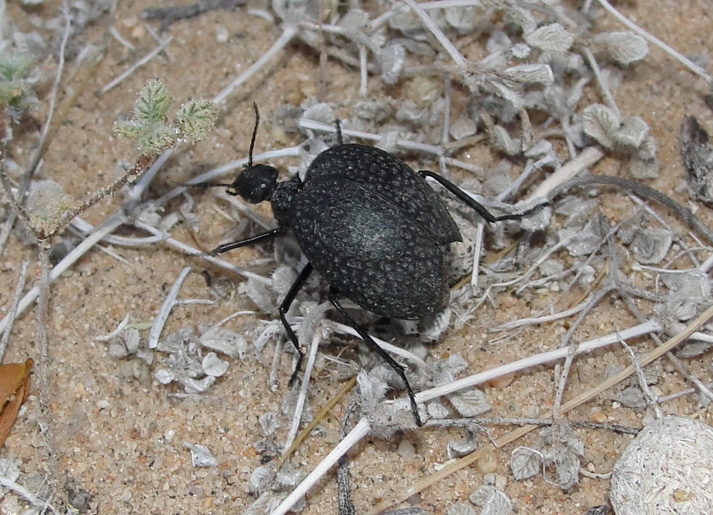
We got there as the sun was going down and found several interesting insects. Jon spotted this impressive blister beetle (Cysteodemus armatus) walking around in the sand among the vegetation along with several other beetles.
I was a bit surprised to find a June beetle feeding (and probably pollinating?) a primrose. I’ve never seen this before. Here's a shot of a Western banded gecko (Coleonyx variegatus) that we found out hunting as soon as the stars came out. It's a bit blanched from the flash.
It was a fun evening (although I did get stung in the lip by a tiphiid wasp). In the morning as we were driving away, we spotted a kit fox pup (Vulpes macrotis - the "big-eared fox") emerging from its den to enjoy the early sun. It sure was a cute thing.
Sunday, April 28, 2013
Black-Chinned Hummingbird at Arroyo Seco
Late April is a great time to visit Arroyo Seco in Monterey, County, California (just a few miles west of Greenfield). There is a dirt road that winds up past the parking area but this is gated and you have to walk in to enjoy the canyon and the pretty emerald green stream that runs at the bottom.
The hills here are covered in wildflowers. And for me the most impressive were the many pale orange monkey flowers.
I watched several carpenter bees try and get at the nectar from the outside with their strong mandibles without success. Apparently the long flowers are too difficult for them to enter otherwise.
I also noticed several black-chinned hummingbirds flying about - and managed to catch this one juvenile on film feeding from a horse-mint flower.
I snapped a shot of the adult male the following morning not far from the trail (road) head.
Saturday, November 24, 2012
Big Baldy
Big Baldy is a very worthwhile, and fairly easy, hike in King's Canyon National Park (in California). It is only a couple of miles from the trail head (which is just a few miles from the park entrance on Highway 180) and climbs maybe 1,000 feet. The top of Big Baldy itself is just over 8,000 feet. We decided to make the effort the day before Thanksgiving.
There was a bit of snow in sections of the trail, which is to be expected in November at this elevation. But the trail was nice and the view on top was well worth the effort. We could see the backbone of the High Sierra to the east, rolling hills in every direction, and even the top of the coastal range far to the west (thanks to Drew's sharp eyes). The valley was hazy but air moving in from the west was clearing up the atmosphere. We watched as rain fell from isolated clouds all around us.
This is definitely a hike for young and old alike - for anyone who likes to be outside and enjoy a walk in the woods - as long as the weather permits. The picture below is of Drew, Jon, and Michael at the trail head.
There was a bit of snow in sections of the trail, which is to be expected in November at this elevation. But the trail was nice and the view on top was well worth the effort. We could see the backbone of the High Sierra to the east, rolling hills in every direction, and even the top of the coastal range far to the west (thanks to Drew's sharp eyes). The valley was hazy but air moving in from the west was clearing up the atmosphere. We watched as rain fell from isolated clouds all around us.
This is definitely a hike for young and old alike - for anyone who likes to be outside and enjoy a walk in the woods - as long as the weather permits. The picture below is of Drew, Jon, and Michael at the trail head.
Sunday, September 30, 2012
Graveyard Peak
Graveyard Peak is an infrequently climbed peak in the Sierra Nevada wilderness above Lake Edison (in the eastern end of Fresno County, California). I'm not quite sure what prompted me to climb it, other than a request from my son Michael to climb a mountain this year before the cold weather set in. Graveyard Peak caught my attention as I glanced over several maps looking for possibilities. I'm very glad we climbed it. Not that it was easy - in fact it was quite difficult. But the view along the way, and especially at the top, was indescribable.
Michael, Jon and I left Fresno at 5:00 yesterday morning and drove to Shaver Lake to pick up my friend Chad. We then drove another couple of hours along winding mountain roads to the Devil's Bathtub (an alpine lake) trailhead. It is at a parking area on the west side of the Lake Edison dam. The walk to Devil's Bathtub lake took us a couple of hours and was quite pleasant. It is 4 and a half miles from the trailhead and only climbs about 1,400 feet - not that bad of an ascent. As far as nice alpine Lake go, Devil's Bathtub is something to experience. It is much larger than I expected and has several nice camping areas. And the view is beautiful. You can see the lake with Graveyard peak in the background (upper right corner) in the group picture (below).
The hike from the lake up to Graveyard Peak (visible above the lake) is quite a different story. It goes up at a steep angle and there is no trail. You have to climb over 2,000 feet through stones and dwarf manzanitas. The last 1,000 feet is all boulders with a few sandy areas between. It isn't easy. There is a trail up to Graveyard Lakes that takes you closer to the peak than the scramble above Devil's Bathtub. But the climb from Graveyard Lakes to the peak is much too steep and dangerous to try unless you're an experience climber.
We didn't risk climbing the last 100 feet to the precarious summit from the ridge. We stopped at the point where I took the picture (above). But the view from ridge was beyond description. We counted over a dozen visible alpine lakes and the long chain of the Sierra backbone along with countless other ridges and forests. We didn't want to come down.
Sunday, September 9, 2012
Heart Lake
We took a little trip over to the east side of the Sierra Nevada (in California) last weekend. Since I am an early riser, I got out of bed one morning while it was still dark outside and the family was asleep, and hiked to Heart Lake above Mammoth Lakes.
The lake is not very big and the hike (from the campground and small ghost town above Lake Mary) was maybe a bit over a mile long (each way) with a gain in altitude of maybe 500 feet. The air was cool, changing from the mid 50's at the paarking area to just at freezing at the lake (at around 9,300 feet). But I loved the hike. The air was fresh and the view of the rising sun reflecting off the rim of the Sierra was impressive.
There is also a nice stand of mountain hemlock (Tsuga mertensiana) around the lake which is a tree I don't run into very often. You can see them in the following picture.
The view of Lake Mary as the sun comes up is worth the short hike. What beautiful country.
Sunday, July 8, 2012
Freeman Creek Bears
I had my first really good look at a wild bear yesterday morning in the Freeman Creek Grove east of Porterville (California). I was by myself (probably not the best thing) enjoying a short backbacking trip into a forest conataining many sequoias. The entire area is very impressive. There is a nice diversity of trees (besides the sequoias) and the forest is managed to leave many old snags alone. This makes for a habitat rich for bears. The undersotry contains a lot of fallen trees in various stages of decay (harboring bear food).
I was stunned and very impressed. I also decided that it was time for me to pick up camp and head on my way. I had only just started to do so when another bear, this one a bit smaller and darker brown, bounced into my camping area. I'm guessing that this was the big boy's girlfriend. We were both startled by each other's presence at the same time. When I reached for my camera, she got spooked and ran away - at least partially. Some 30 feet off, she turned to look back my way. I tried to make my camera work but only got a poor picture. She then left with a huff and I never saw either one of them again. I have, however, been thinking of them a lot. It was a magnificent, yet frightening, experience. Next time, however, I am going camping with a bear-sized can of pepper spray. Just to be on the safe side.
Just before bedding down for the night, I discovered a fresh bear scat near a copse of sequoias conatining very suitable sleeping places for bears. I was impressed enough with the area that I decided to move elsewhere to sleep. I also made sure all my food was in a bear canister (which is required by law) that I kept a distance from my camp. Early the next morning I woke up and was enjoying the fresh day in my sleeping bag when I heard the sound of breaking branches and of bark being stripped off of dead trees. I also realized that the sound was not coming from the direction of the trail. I put my shoes on, gathered my camera, and quietly got out of bed. I was a little bit nervous.
I saw the bear before he saw me (I'm assuming it was a male - since I'm guessing it weighed close to 400 pounds, which is bigger than females are known to get). He was light brown and only about 70 feet away. Fortunately there were two fallen logs between him and me. My adrenalin started to take control of my judgment at this point (hence the poor quality of the pictures). Fortunately, I didn't run. I did, however, remember that black bears are not normally aggressive to humans - especially if the humans appear big enough and aren't threatening their cubs.
Just as I thought this, the bear discovered I was nearby (probably cought my scent) and hopped over the first log in my direction. This definitely got my attention. In fact it was a real rush. I was certainly a bit scared (maybe more than a bit). Acting on instinct, I stood up next to the fallen log in front of me and tried to look very big. The bear stopped and looked around. Then it saw me and we watched each other for several seconds. At this point it was only 40 - 50 feet away (I measured the distance later). After a few clumbsy attempts at taking a picture, I watched in releif as he gave me a grunt and then climbed back over the log and hopped away.
I was stunned and very impressed. I also decided that it was time for me to pick up camp and head on my way. I had only just started to do so when another bear, this one a bit smaller and darker brown, bounced into my camping area. I'm guessing that this was the big boy's girlfriend. We were both startled by each other's presence at the same time. When I reached for my camera, she got spooked and ran away - at least partially. Some 30 feet off, she turned to look back my way. I tried to make my camera work but only got a poor picture. She then left with a huff and I never saw either one of them again. I have, however, been thinking of them a lot. It was a magnificent, yet frightening, experience. Next time, however, I am going camping with a bear-sized can of pepper spray. Just to be on the safe side.
Wednesday, February 29, 2012
New Army Pass
Hiking the trail over New Army Pass (From Inyo County, California) is a high country adventure worth making. The pass itself is right on the boundary between Inyo and Tulare Counties. From the Inyo County side (take the road SW from Lone Pine up into the parking area) the trail passes through Cottonwood Lakes – a cluster of high elevation lakes that feed from snow melt near timber line (over 10,000 feet). We spent three days in this magnificent country two years ago (in July) and had a wonderful time. There are a number of foxtail pine (Pinus balfouriana) groves which are uncommon anywhere else on the eastern side of the Sierra. This picture is of one of the Cottonwood Lakes just east of New Army Pass.
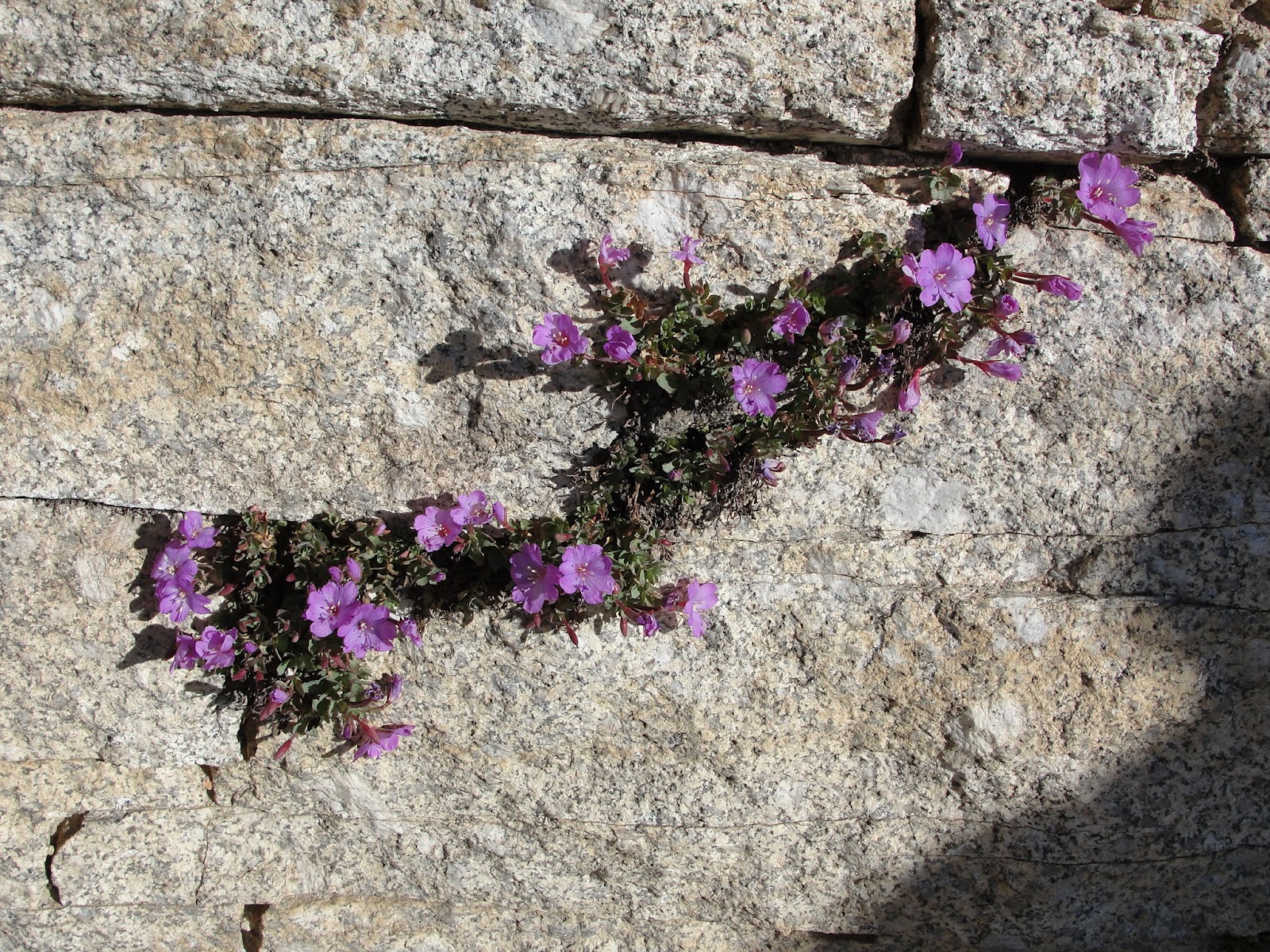
Even in the summer there can be a morning frost on the ground at this elevation. The plants are all well adapted to grow and bloom in this harsh environment. This second picture is of rock fringe (Epilobium obcordatum) that we found holding to a rock face just below the pass. This is a cold and windy holdout, and there were pockets of snow not far away. It is a remarkable plant in a remarkable place.
Here are the three of us (me, Michael, Spencer) a bit travel-weary but happy among the foxtails. You can almost see how spectacular the air is
Monday, January 9, 2012
The Middle Fork of the Tule River
The Middle Fork of the Tule River runs through Wishon Campground east of Porterville, California. It is a nice place to enjoy the Sierras in the winter. The campground’s elevation is just under 4,000 feet, which means that winter campers will often wake up with frost on the ground (as we did last month) although it will quickly disappear. The forest is quite diverse with valley (Quercus lobata) and canyon (Q. chrysolepis) oaks intermixed with California incense cedar (Calocedrus decurrens), white fir (Abies concolor) and ponderosa pine (Pinus ponderosa). There are also giant sequoias (Sequoiadendron giganteum) just up the trail in Mountain Home State Forest. The giant tree next to Spencer is the largest canyon oak I’ve ever seen. It’s near the bank of the Middle Fork of the Tule River maybe a mile above Wishon campground (you’ll come to a fork in the trail and will want to take the lower path leading down to the river). There’s a large hole at the base big enough for a grown man to sleep in and cook dinner on a stove.
But what surprised me most on our hike (along the trail just north of the campground) was the small groves of California nutmeg (Torreya californica) that grow like inconspicuous understory shrubs. In fact, at first, I passed several and wondered at their large flat needles, trying to figure out what sort of fir it could be. I didn’t realize that California nutmegs occurred so far south. As I was to learn later, this is probably the southern-most distribution of the species. Although I bet a few may creep over into Kern County if somebody were to make an effort to find them there.
This last picture is of a waterfall along the trail maybe two miles above the campground. It’s a nice place to relax and there’s a great swimming hole just below. I think I’ll be coming back for a swim when it’s warmer.
Subscribe to:
Posts (Atom)