Thursday, April 5, 2012

Litocala sexsignata

The day-flying moth Litocala sexsignata is out and about these days in the foothills of Southern California. We found this one a few days ago above Porterville (in Tulare County, California). It was sunning itself on a large riparian boulder and, as you can see (or can you), it fits in very well with the background color. It’s really only the abraded thorax that makes it easy to see.


It’s about the size of a typical night-flying noctuid – about an inch long and the larvae are known to feed on oak and possibly manzanita.


The habitat shot is of the North Fork of the Tule River at Wishon Campground. At 4,000 feet you can see that there is still a lot of spring yet to come.

Saturday, March 24, 2012

Celastrina ladon

This is the spring azure (Celastrina ladon) that Michael, Drew and I came across three weeks ago on a hike to Marble Falls in Sequoia National Park (above Visalia). There were several bouncing above (and lapping from) a mineral rich seep on the trail.


 The butterfly is a member of the gossamer-winged butterfly family Lycaenidae - comprised of the smallest butterflies in our fauna. This one is a Western species that can be seen on warm days in the spring - usually in mountain areas at lower elevations. They are quite delicate, and with a good look, quite captivating. 


Marble Falls itself is a beautiful place. The spring run-off made for quite a cascade. The pool here by Michael looks like a great place to take a swim in July. It's a bit over 4 miles from the trailhead (that starts at Potwisha Campground). Although I can't vouch for it still being full and deep later in the year.


Tuesday, March 20, 2012

Imantodes cenchoa

The blunt-headed tree snake, Imantodes cenchoa, is a startling creature to stumble into at night. My encounter with this individual occurred a couple of years ago on the Osa Peninsula (in June) in southern Costa Rica. There were no sounds of rustling leaves or slithering scales from the ground. This snake came winding (silently) out of a tree, passed along an available branch and spread its full body over an enormous leaf a few feet from my disbelieving stare.


You would think that an experienced entomologist would be unflinching under such circumstances – and indeed my hunting instincts become fully active upon hearing the low buzz of a night-flying beetle. But snakes are different. When I see them unexpectedly, they can give me the spooks. Fortunately I recovered in time to take a picture. It’s an impressive creature, for sure.


The picture of the coast was taken the next day about a mile from where we found the snake.

Wednesday, March 7, 2012

Odonteus obesus

Odonteus obesus is one of the two species of geotrupid scarabs most likely to be found in the Sierra Nevada (of California). It is about a centimeter long, is nearly black, and sports (in males) a prominent horn on its head. This individual is a female with little cephalic armature.


It came to a light last June at an elevation of about 5,000 feet near Shaver Lake (Dinkey Creek Campground) above Fresno. These compact scarabs are always fun to find.


The habitat was mixed Jeffrey pine, incense cedar and Douglas fir.

Wednesday, February 29, 2012

New Army Pass

Hiking the trail over New Army Pass (From Inyo County, California) is a high country adventure worth making. The pass itself is right on the boundary between Inyo and Tulare Counties. From the Inyo County side (take the road SW from Lone Pine up into the parking area) the trail passes through Cottonwood Lakes – a cluster of high elevation lakes that feed from snow melt near timber line (over 10,000 feet). We spent three days in this magnificent country two years ago (in July) and had a wonderful time. There are a number of foxtail pine (Pinus balfouriana) groves which are uncommon anywhere else on the eastern side of the Sierra. This picture is of one of the Cottonwood Lakes just east of New Army Pass.


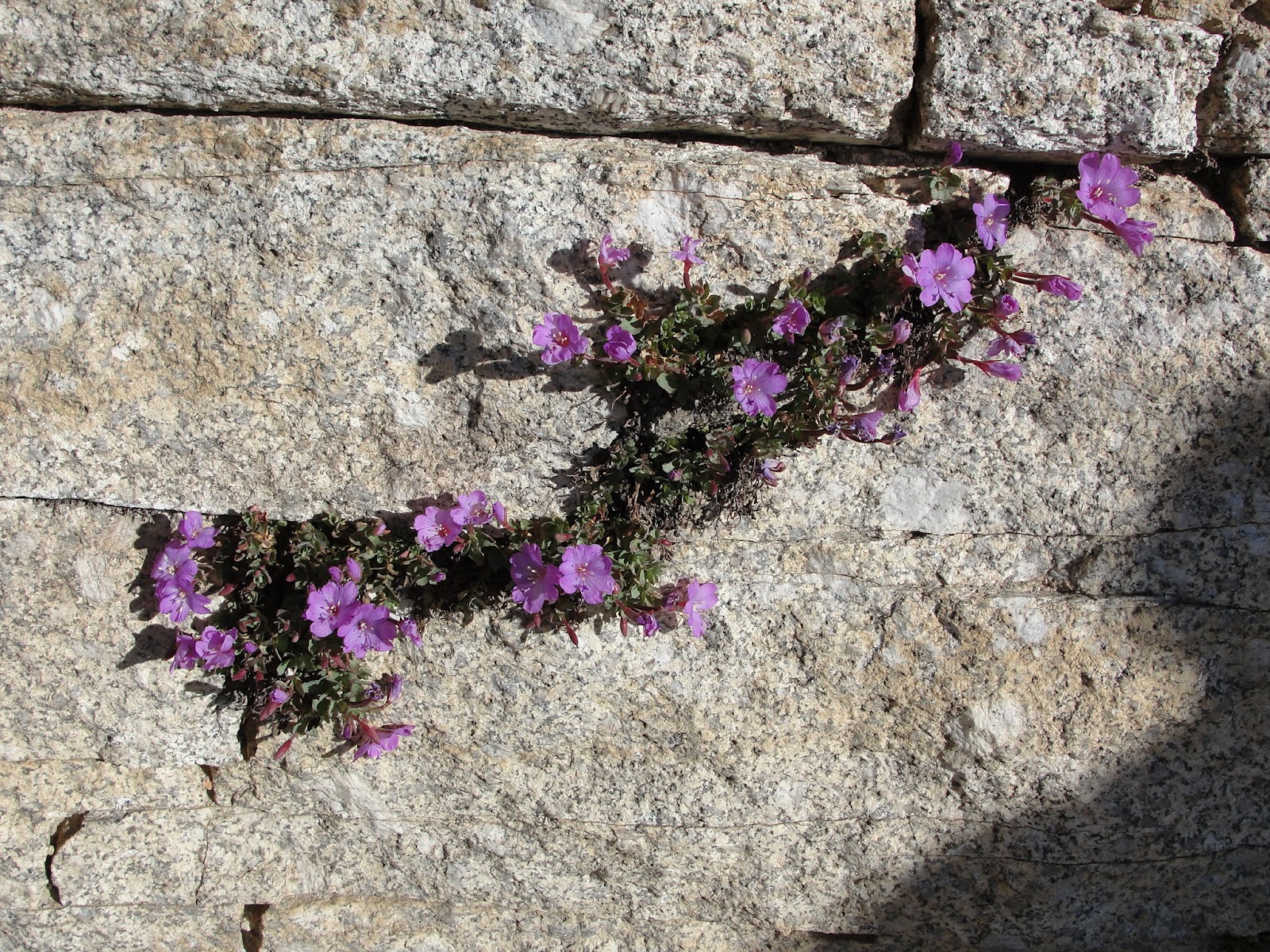
Even in the summer there can be a morning frost on the ground at this elevation. The plants are all well adapted to grow and bloom in this harsh environment. This second picture is of rock fringe (Epilobium obcordatum) that we found holding to a rock face just below the pass. This is a cold and windy holdout, and there were pockets of snow not far away. It is a remarkable plant in a remarkable place.


Here are the three of us (me, Michael, Spencer) a bit travel-weary but happy among the foxtails. You can almost see how spectacular the air is


Monday, February 20, 2012

Scaphinotus ventricosus and S. striatopunctatus

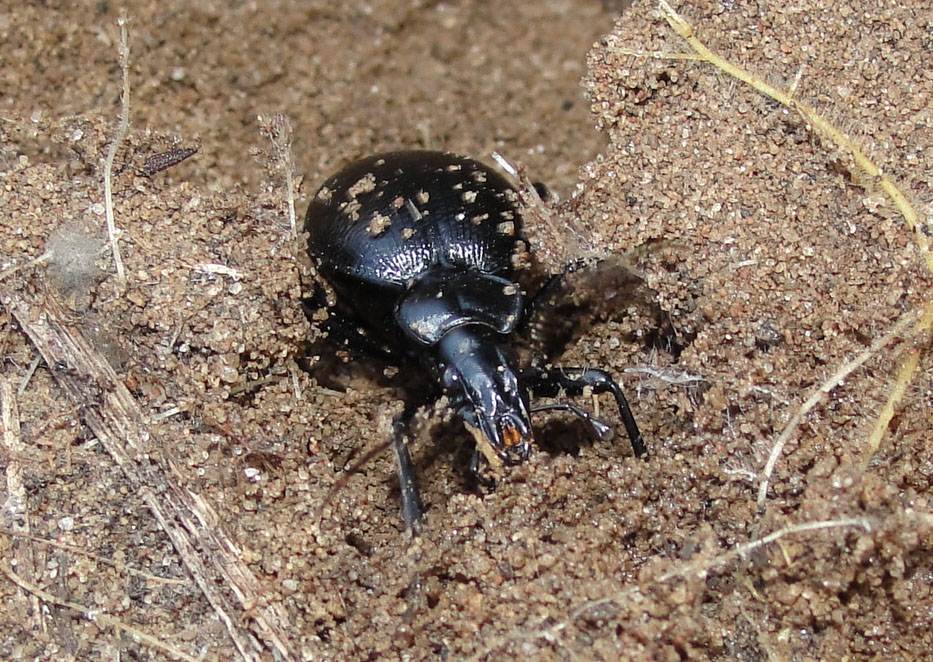
The snail-eating ground beetles (genus Scaphinotus) are a diverse group in California (see my post for May 21 of last year for a note on S. subtilis). We have several in the Sierra, several more along the coast and a handful in other places. A month ago we were camping near Watsonville (in Santa Cruz County) and I found a small meadow near the campground with a few boards that had been left lying on the ground. I turned some of them over and found two different species, S. ventricosus (the smaller one below at around 13mm long).


and S. striatopunctatus (the larger one in the second picture at around 18mm long).


They were of noticeably different sizes at least in this particular place. Some of this may be a partitioning of their habitat (because of an immediate sympatry). The size range of both species normally overlap quite a bit (at least in museum series). Here, however, they were easy to tell apart based on size alone.


Monday, February 6, 2012

Ellychnia megista

There is a subdued grandeur in a redwood forest. Animal sounds are often muffled and seemingly distant. The forest floor is covered with deep green ferns and other shade-loving plants. One doesn’t expect to see large numbers of insects, especially in the winter months. Of course, the California coast is not completely dormant this time of year and a patient observer will still discover a few creatures finding their way around. So it was that we came across this attractive firefly in the Forest of Nicene Marks State Park (in Santa Cruz County) a couple of weeks ago.


The Forest of Nicene Marks State Park is primarily a second-growth redwood forest. It was logged extensively last century but the owners decided to protect the area in subsequent years and gave the park to the State of California. It is a fairly large area (as state parks go) and there are a number of nice trails. During our visit, we discovered a side trail with few hikers along Aptos Creek where there were remains of old growth redwoods. It was cool but not cold and a few stoneflies could be seen flying above the water as they moved into illuminating pockets of sunbeams. I took a short detour to an area of old redwood stumps and was trying to get my mind around the age of the erstwhile giants, when this firelfly landed on one of the dead logs.


It is a species of Ellychnia (E. megista to be precise) that does not have lumenescent organs – a light-less firefly if you will. There are several species in the the US. The more commonly seen E. californica occurs throughout California. It has been known for over a hundred years. On the other hand, E. megista is restricted to the coastal area and was described fairly recently (in 1970) by Ken Fender. The Type locality is Santa Cruz County. Who knows, it may have lived in the same forest. It is most easily recognized by the parallel-sided black band running down the center of the pronotum.