Saturday, October 29, 2011

Yosemite's Tame Coyotes

There are a couple of tame coyotes in Yosemite National Park these days. Kathy and I came across a pair a couple of weeks ago as we were driving north along Highway 41 about 30 minutes north of the park's southern entrance. I've learned that it pays when travelling in national parks to pull over immediately when confronted with a traffic jam (something I've learned from my friend Steve). People are often stopped to take pictures or just to look at some interesting natural phenomenon. This time it turned out to be a big dog (two actually): Canis latrans, commonly known as the coyote.


I've seen a number of coyotes in my life and when I saw this one, I was impressed by its size. For a second I wanted to believe that it might just be a small wolf. Maybe California introduced a pack of wolves, I thought. But the longer I watched the creatures, the more I realized that this wasn't likely. These two animals seemed almost tame. They made no attempt to leave the line of clicking cameras and seemed to be all but asking for hand-outs.


After spending a lovely day in Yosemite Valley, we returned and found the same animals on the same stretch of road as before. At this point I was certain that we were looking at tame coyotes. More cars were stopped and tourists were taking pictures. The thought went through my mind that this animal is known to be the bane of ranchers. People are willing to pay money for their pelts. But you have to admit that they're attractive animals and make for a nice show. Yosemite could do worse.


Monday, October 17, 2011

California Sister

Last weekend Kathy and I spent a day hiking (and biking) around Yosemite Valley. It was a great time to visit the park. The heavy traffic of the summer months was gone, and although there were still many visitors, it wasn't crowded. I don't normally go out of my way to visit national parks because it isn't possible to collect insects without a permit (and permits are usually not worth the trouble getting). But Yosemite Valley can't be avoided indefinitely - especially if you live only a couple of hours away.


This California sister (Adelpha californica) flew by right as we were leaving the Yosemite Visitor's Center. It was circling around the entranceway and I waited for it to land so I could take a picture. Unfortunately, people kept disturbing it each time it landed. I was a little disappointed by how many people didn't even notice it - such a striking insect, and so close. Finally, however, it landed on a manzanita bush nearby and then proceeded to pose for me while I carefully approached it. It is a really beautiful insect. It gets its name for the black and white pattern that is reminiscent of a nun's habit and can be distinguished from other similarly-colored butterflies by the orange/red spots being separated from the wing margin. It feeds on oaks.


The valley itself was cool most of the day with occasional clouds. It had rained earlier in the week and there was a dusting of snow on top of Half Dome. The leaves will be turning soon, I expect. It was hard to leave such a spot - claimed by many to be the most beautiful place on earth.


Sunday, October 9, 2011

Latrodectus geometricus

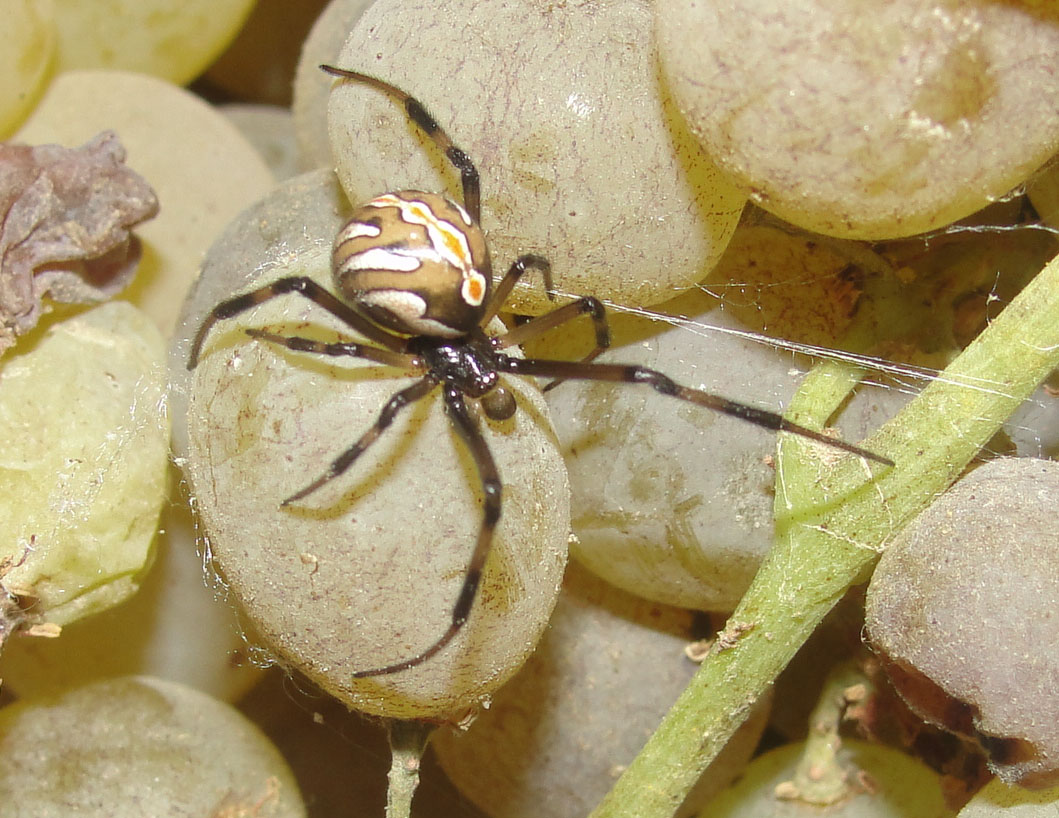
It's grape harvesting time in the Central Valley - actually, it's just coming to an end. It's a couple of weeks behind schedule because of the cooler and wetter spring but the bugs have eventually caught up with the season. Last week while going through several bunches of grapes, a colleague of mine stumbled onto this attractive relative of the black widow spider - the brown widow, Latrodectus geometricus.


This spider is not known for its nasty bight, although it can and, if provoked, will. What is striking is the pretty pattern on its back. It is actually not originally from the US. Having come from Africa some time ago, it seems to prefer the subtropical regions of the US - particularly Southern California. One message from all of this: maybe wear gloves if your in the vineyard.


Saturday, September 24, 2011

Pseudanostirus pudicus

Here's a click beetle that tends to fairly local in the Rocky Mountains. It can be common in Utah but it is often poorly represented in collections outside the area. It looks similar to the more widespread P. propola but lacks the bold elytral markings. They tend to be more diffuse in P. pudicus.


I found this one at about 6,000 feet up American Fork Canyon (Utah County, Utah) a month ago just as the sun was setting. It was resting on stream-side vegetataion when I discovered it.  I've seen it at elevations as high as 8,000 - 9,000 feet. 


Monday, September 19, 2011

Tragosoma pilosicornis

Tragosoma pilosicornis is small as far as prionid longhorn beetles go. It's a substantial insect, however, by other criteria. This individual is about an inch long but like other bycids, when it extends its antennae, it seems much bigger. This one came bumbling in to my blacklight a week ago just below Sequoia National Park in Tulare County, California (at about 4,700 feet). The main trees in the vicinity were ponderosa pine and incense cedar.


This species is not nearly as common as T. depsarium which also occurs in California (and much of the West and across the Northern Hemisphere). It is also quite a bit less hairy than its more common relative and has very noticeable pitting on the anterior half of the wing covers.


This is the first time I've seen T. pilosicornis alive. The habitat shot is a morning view after Michael and I pulled ourselves out of our sleeping bags.


Saturday, September 3, 2011

Cosmosalia chrysocoma

Here's a Rocky Mountain longhorn beetle, Cosmosalia chrysocoma. It's one of those variable lepturines with a fairly wide distribution (throughout Canada and in much of the Western US) but with populations that can look unique. It can often be found on flowers. I found this one on a thistle bud.


Some of individuals are much darker (with the black base color showing through the elytral pubescence). I have also seen specimens that almost look gold. I found this one just before dusk up American Fork Canyon (in the same place as the giant ladybird beetle of my last post).


The habitat is spare scrub oak and sagebrush with Douglas fir and boxelder along the canyon floor. It's always a good day when you find bycids about.


Tuesday, August 30, 2011

Anatis lecontei

We have a handful of giant lady bird beetles in the US. Most of them (four) belong to the genus Anatis. And what's really nice about them is that they're native. Somewhere around half of our lady beetle fauna is introduced - having come aboard on (mostly) misguided efforts to control plant pests (such as aphids and scales). Many of them are competing (sometimes out-competing) our native species.


This species, Anatis lecontei, is fairly common in the certain places of the Rocky Mountains. I found this one up American Fork Canyon (Utah) a couple of weeks ago. It's hard to to get a good sense of scale but it is about 4 to 5 times bigger than your common lady bug. The shadow also obscures a black band that encircles the elytra. It's a handsome creature. The habitat shot is up Tibble Fork Canyon.