Showing posts with label Birds. Show all posts

Monday, March 31, 2014

Panama Bird List

Following is a list of bird species seen in Panama during the second week of March, 2014 – by Steve Bonta, Jon Quist and myself. We started the week along Pipeline Road near the Panama Canal, worked our way west and up into the area around El Valle, then drove over to Bocas del Toro and finally back to ChitrĂ© to end the week.

Magnificent Frigatebird, Sandwich Tern, Laughing Gull, Herring Gull, Neotropic Cormorant, Brown Pelican,


Ruddy Ground Dove, Tropical Kingbird, Turkey Vulture, Black Vulture, Great Tailed Grackle, Yellow-headed Caracara, Rock Pigeon, Spotted Sandpiper, Fork-tailed Flycatcher, Yellow-rumped Cacique, Plain Xenops, Song Wren, Cattle Egret, Great Egret, Golden-collared Manakin, Red-crowned Woodpecker, Crimson-backed Tanager, Black-chested Jay, Blue Cotinga, Louisiana Waterthrush, rufous-capped Warbler, Scarlet-rumped Tanager, Common Bush Tanager, Savannah Hawk, Crested Caracara, American Kestrel, Great Black Hawk, Anhinga, Wood Stork, Red-breasted Blackbird, Crested Oropendola, Green Ibis, Southern Lapwing (third picture), Northern Jacana, Purple Gallinule, Great Kiskadee, Swallow-tailed Kite, Pale-vented pigeon, Slate-colored Seedeater, Blue-black grassquit, Spectacled Antpitta, Smooth-billed Ani, Amazon Kingfisher, White-tailed Kite, Yellow-crowned Night Heron, Tricolored Heron (first picture), Snowy Egret, Keel-billed Toucan, Common Tody Flycatcher, Masked Tityra, Little Blue Heron (second picture), White-shouldered Tanager, Osprey, Montezuma Oropendola, Large-billed Tern, Yellow-rumped Warbler, Prothonotary warbler, Semipalmated Plover, Willet, Whimbrel, White Ibis, Buff-breasted sandpiper, Straight-billed Woodcreeper, Clay-colored Thrush, Red Knot, Black-necked Stilt, Plain-breasted Ground Dove
 

Wednesday, January 22, 2014

December Birds at Joshua Tree National Park

Last month I took a side trip through Southern California's Joshua Tree National Park. December is an odd time of the year to make such a trip. There are very few plants blooming and much of the wildlife is hunkering down. But I had the time so I took the trip anyway.


I was in for a bit of a surprise when I stopped behind the northeast Visitors Center where there is a desert oasis of sorts. Flitting around in the palms was a bold cactus wren, that didn't seem to be bothered by me at all. 


The ranger in the gift shop suggested that I walk along the path and check out the phainopeplas that were feeding on the mistletoe berries.


The above picture is of the uneaten berries. The picture below is of the digested ones on a wildlife marker. I sort of got the idea that phainopeplas don't like rabbits.


Sunday, November 3, 2013

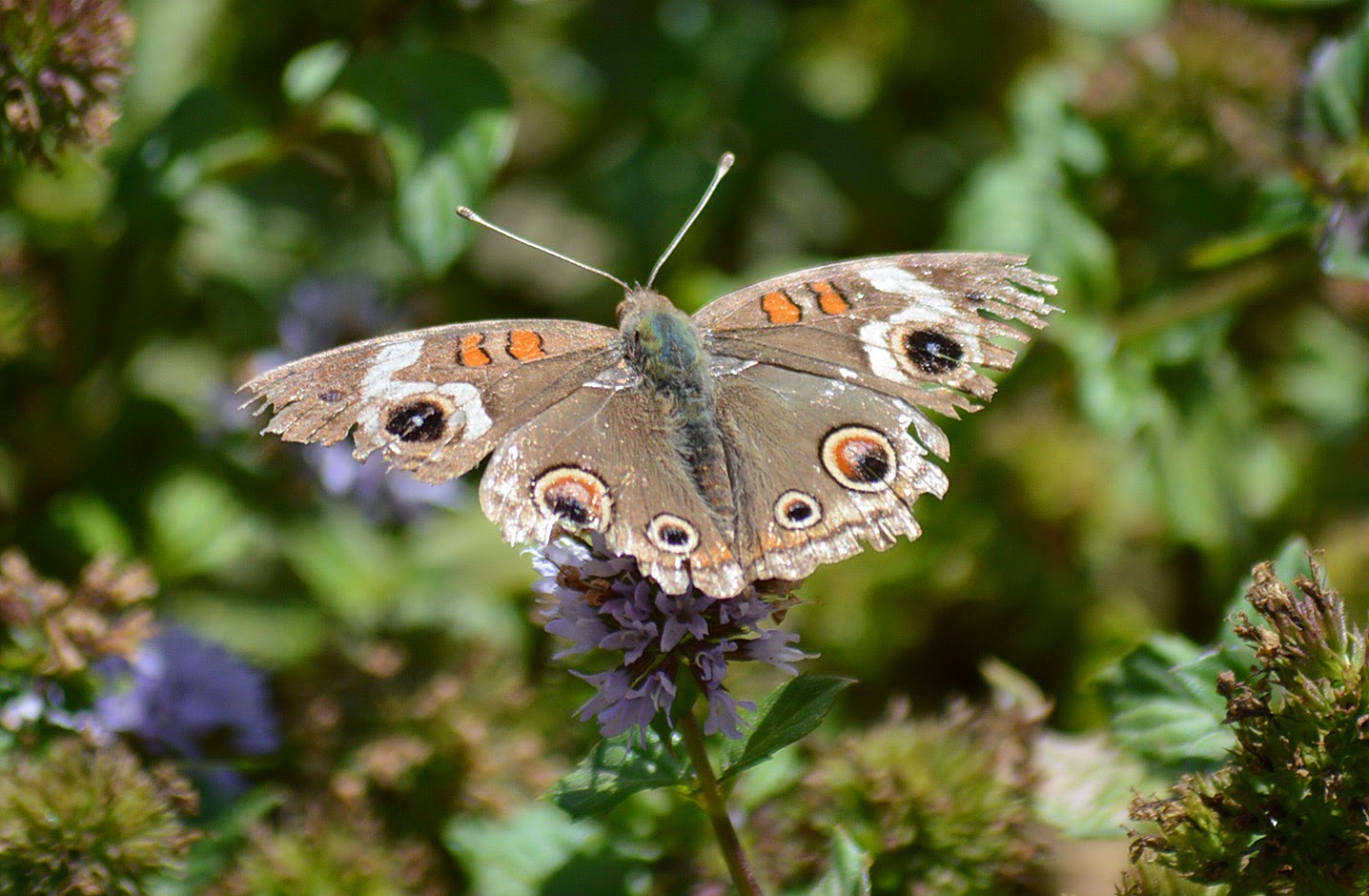
Tired November Butterflies

It's now the beginning of November and still the rains have not come to Fresno with any sort of confidence. Our days are very pleasant in the 70's and the nights hardly get into the 40's. This is not unusual. Very often the first rains don't come until around Thanksgiving time, or even later. What this means for many of the late summer and fall insects is that they continue their lives without finding a place to over-winter, or of succumbing to the elements.  They linger and they get worn out by their long lives.


Here is a gray hairstreak (Strymon melinus) that Kathy and I ran into along the path by Cottonwood Park yesterday while we were out enjoying the warm weather. It has lost much of its delicate wing "tail" and many of its cloudy gray scales - still a beautiful butterfly but clearly tired out.


The common buckeye (Junonia coenia) was also out along the narrow stream bank in the patches of flowering mint. I was amazed that such a worn-out creature could still fly.


There is also a catchment basin by the park with a gathering of waterfowl. A snowy egret (Egretta thula) was kind enough to fly close enough for a picture. I was impressed by the striking yellow markings on the face and legs when seen up close.


Sunday, September 22, 2013

Oso Flaco Lake

Earlier this month while traveling in San Luis Obispo County (along coastal California) I noticed an interesting state park with ample coastal dune habitat. I decided to stop and have a look.


I'm glad I did, it was a beautiful day (as most summer days are along the coast) and the lake was alive with waterfowl. A nice boardwalk bridge extends from the main path over the lake and a well-maintained trail continues on to the beach through rich coastal dune habitat.


I came across this Boisduval's blue (Icaricia icarioides) feeding on California aster (Lessingia filaginifolia) and a little further along I was able to catch a picture of a California thrasher


With a beautiful yellow ice-plant (the marigold ice-plant, Conicosia pugioniformis) in bloom nearby.


 On the way back I caught a young phalarope swimming in the lake.


Sunday, April 28, 2013

Black-Chinned Hummingbird at Arroyo Seco

Late April is a great time to visit Arroyo Seco in Monterey, County, California (just a few miles west of Greenfield). There is a dirt road that winds up past the parking area but this is gated and you have to walk in to enjoy the canyon and the pretty emerald green stream that runs at the bottom.


The hills here are covered in wildflowers. And for me the most impressive were the many pale orange monkey flowers.


I watched several carpenter bees try and get at the nectar from the outside with their strong mandibles without success. Apparently the long flowers are too difficult for them to enter otherwise.


I also noticed several black-chinned hummingbirds flying about - and managed to catch this one juvenile on film feeding from a horse-mint flower.


I snapped a shot of the adult male the following morning not far from the trail (road) head.


Saturday, January 19, 2013

The Laughing Kookaburra

Here are a couple of handsome birds (laughing kookaburras) that I found in the Memphis Zoo a few months ago. They're from eastern Australia. They are known for singing regularly just before sunrise and just after sunset. They eat mostly insects but are also know to eat rodents snakes and even other bird eggs.

Saturday, November 10, 2012

The Silver Beak Tanager

It occurred to me the other day while visiting the Memphis Zoo that there are a lot of fascinating creatures in the zoos of the world that ought to be more digitally recorded and available. There is a tremendous amount of history (can I call it natural history history?) and zookeeper expertise cloistered behind the fences of these animal parks that goes unrecorded. This is especially true, I think, of some of the smaller creatures that don't draw big crowds - but that might be unique organisms (or specialties) of a particular zoo.


So here is a picture of the silver beak tanager (Ramphocelus carbo) from northern South America, a creature that I have never seen in the wild and probably never will. Yet the good folks at the Memphis Zoo have taken care to make it available for visitors to see. What a beautiful bird.

Saturday, May 26, 2012

Lazuli Bunting

I've always had a warm place in my heart for birds that are blue. When I saw this lazuli bunting (Passerina amoena) a couple of weeks ago, I spent a lot of time trying to get my unsteady hands to cooperate with my point-and-shoot camera. These pictures don't do justice to the beautiful bird but it's what I was able to manage.


I was a few miles east of Dinuba (California) in the Sierra Nevada foothills in a nice spot for birds in general. I tried (unsuccessfully) to get a picture of several phaenopeplas that were diving in and out of the oaks.


The habitat is a mixed oak woodland with elderberry, poison oak and other assorted shrubs (now dry).

Monday, May 17, 2010

California Condors up Close

Twenty Five years ago, I sat at a museum table and read the sad story of North America's largest bird, the California condor. It was doomed for extinction, or so I imagined and many beleived. The few remaining wild birds had no chance to survive given the environmental hazards that confronted them. The last condors were being taken into a captive breeding program in hopes of saving the species but I had no confidence that this would work. My memory of this has remained clear all these years because of the inevitable loss I felt at that time.


I have followed the story of the condor ever since and have been alternately hopeful and doubtful that the impressive bird would ultimately survive. This changed for me two weeks ago when my friend Steve and I took a couple of days to travel along the coastal highway south of Monterey, California. We knew that the birds were spotted occasionally in the area and hoped to see one, but we were also realistically aware of our slim chances. Our tentative hope changed suddenly, however, when we stopped at one of the many pull-offs to look for marine mammals (we did see harbor seals, sea otters and sea lions throughout the day). Steve glanced up and spotted a pair of the magnificent birds soaring overhead. We watched them for maybe a minute before they disappeared behind the hills of the Santa Lucia Range.


This was quite a thrill, but, as it turned out, we were to see several more at much closer range. A few miles south of Big Sur, we noticed several vultures (turkey vultures at first) swirling around a point just off the road. As we got closer it became obvious that several of them had white patches in the wrong place to be turkey vultures. We hurriedly pulled-off the road for a better look and watched for several minutes as a group of about eight condors flew back and forth near the cliffs where we stood. My attempts to photograph them met with mixed success and then the birds moved on. We walked north around a turn in the road and saw a couple resting on a ledge some distance away. Then we got particularly lucky. There was a heavy flapping sound and a group of five landed on a rocky ledge less than 30 feet below us. Then two other birds landed just a few yards away from them. It was truly a magnificent moment for me. The birds I never expected to see were now right in front of me. We could clearly see their wing tags and even the unique color patterns of their heads. They seemed to be posing for a picture and so I obliged them. Then to put a final touch to the moment, a peregrine falcon soared by, just above their perch, and several hundred feet below a raft of sea lions rolled over to take in more sun.