Last month I had a free couple of days and decided to spend them hiking with Kent, Spencer and Erik. We decided to go through the Ashdown Gorge Wilderness (Kent's suggestion) just a few miles east of Cedar City in Utah's red rock country. More than anything I was anticipating just getting away and seeing Cedar Breaks National Monument from the west side. I wasn't even thinking of scenic upland meadows when, after a couple of hours hiking we came into a clearing called Stud Flat.
After all, who would think that a place with such a name would be scenic? I was pleasantly surprised. Rising above the meadow are red rock formations with pine and fir forests all around. We decided that we would spend the night right there even though we weren't all that tired. We just couldn't bring ourselves to leave the place.
Just the week before I had driven through Yosemite's famous Tuolumne Meadows - also a high elevation meadow. It is famous as one of the gems of our (perhaps) most celebrated national park. And yet I can say that it isn't any more beautiful than Stud Flat in the spring. Here's a picture of a pair of large marbles (Euchloe ausonides) that I noticed near the meadow. I guess I should also mention how impressive the gorge is. We spent the following day hiking through its winding canyons. It may be a while before I do the gorge hike again though. But I can say with confidence that I will be back to see Stud Flat sooner than later.
Showing posts with label Lepidoptera. Show all posts
Sunday, July 6, 2014
Sunday, November 3, 2013
Tired November Butterflies
It's now the beginning of November and still the rains have not come to Fresno with any sort of confidence. Our days are very pleasant in the 70's and the nights hardly get into the 40's. This is not unusual. Very often the first rains don't come until around Thanksgiving time, or even later. What this means for many of the late summer and fall insects is that they continue their lives without finding a place to over-winter, or of succumbing to the elements. They linger and they get worn out by their long lives.
Here is a gray hairstreak (Strymon melinus) that Kathy and I ran into along the path by Cottonwood Park yesterday while we were out enjoying the warm weather. It has lost much of its delicate wing "tail" and many of its cloudy gray scales - still a beautiful butterfly but clearly tired out.
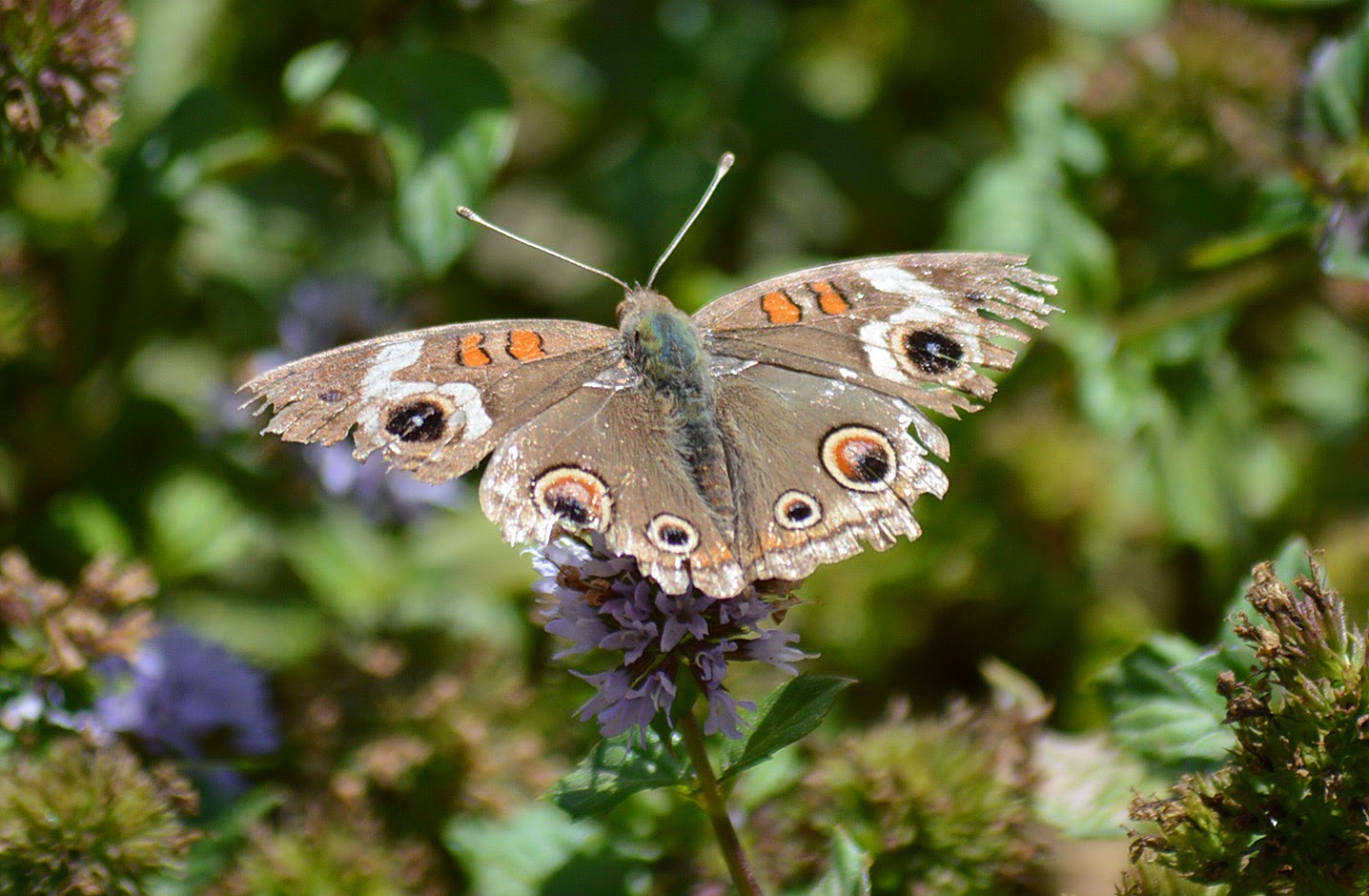
The common buckeye (Junonia coenia) was also out along the narrow stream bank in the patches of flowering mint. I was amazed that such a worn-out creature could still fly.
There is also a catchment basin by the park with a gathering of waterfowl. A snowy egret (Egretta thula) was kind enough to fly close enough for a picture. I was impressed by the striking yellow markings on the face and legs when seen up close.
Here is a gray hairstreak (Strymon melinus) that Kathy and I ran into along the path by Cottonwood Park yesterday while we were out enjoying the warm weather. It has lost much of its delicate wing "tail" and many of its cloudy gray scales - still a beautiful butterfly but clearly tired out.
The common buckeye (Junonia coenia) was also out along the narrow stream bank in the patches of flowering mint. I was amazed that such a worn-out creature could still fly.
There is also a catchment basin by the park with a gathering of waterfowl. A snowy egret (Egretta thula) was kind enough to fly close enough for a picture. I was impressed by the striking yellow markings on the face and legs when seen up close.
Sunday, September 22, 2013
Oso Flaco Lake
Earlier this month while traveling in San Luis Obispo County (along coastal California) I noticed an interesting state park with ample coastal dune habitat. I decided to stop and have a look.
I'm glad I did, it was a beautiful day (as most summer days are along the coast) and the lake was alive with waterfowl. A nice boardwalk bridge extends from the main path over the lake and a well-maintained trail continues on to the beach through rich coastal dune habitat.
I came across this Boisduval's blue (Icaricia icarioides) feeding on California aster (Lessingia filaginifolia) and a little further along I was able to catch a picture of a California thrasher
With a beautiful yellow ice-plant (the marigold ice-plant, Conicosia pugioniformis) in bloom nearby.
On the way back I caught a young phalarope swimming in the lake.
I'm glad I did, it was a beautiful day (as most summer days are along the coast) and the lake was alive with waterfowl. A nice boardwalk bridge extends from the main path over the lake and a well-maintained trail continues on to the beach through rich coastal dune habitat.
I came across this Boisduval's blue (Icaricia icarioides) feeding on California aster (Lessingia filaginifolia) and a little further along I was able to catch a picture of a California thrasher
With a beautiful yellow ice-plant (the marigold ice-plant, Conicosia pugioniformis) in bloom nearby.
On the way back I caught a young phalarope swimming in the lake.
Sunday, July 28, 2013
Alpine Butterflies near Disappointment Lake
Earlier this month a handful of us from Fresno took a 35 mile hike just east of Courtright Reservoir (in Fresno County) in the Sierra Nevada of California. Along the way we saw several beautiful butterflies – some of which I was lucky enough to get pictures of.
Further up the trail toward Disappointment Lake (the name of which is a clear misnomer) I found one of the butterflies in the arctic blue complex (Agriades franklinii) feeding on Western bistort (Polygonum bistortoides).
These first two pictures are at Post Coral Creek where this lovely greenish blue (Plebejus saepiolus) was enjoying the sun and white daisy.
Further up the trail toward Disappointment Lake (the name of which is a clear misnomer) I found one of the butterflies in the arctic blue complex (Agriades franklinii) feeding on Western bistort (Polygonum bistortoides).
And then even further up the trail (actually on boulders where there was no trail) just below the LeConte Divide we spotted a handful of checkerspots (in the Edith’s checkerspot complex – Occidryas editha). This is an amzing place for butterflies – at 11,000 feet on a windswept ridge where trees don’t even grow. What a beautiful place.
Sunday, June 23, 2013
Butterflies on Desert Catalpa
Last month, Jon and I took a detour on a dirt
road several miles SE of Baker, California. It lead to a dry wash filled with desert catalpa (Chilopsis linearis) in full bloom.
We found sphecid wasps (one just visible in the upper right corner in the picture above), a few species of bees and several butterflies all competing with each other in a feeding frenzy. The sleepy
oranges (Eurema nicippe) disregarded
any sense of caution and plunged much of their bodies inside to get at the
nectar (making it easy to snap pictures).
The lovely great purple hairstreak (Atlides halesus) with metallic blue and
red scales was a bit more wary.
Tuesday, April 2, 2013
Kodiosoma fulvum
Here's a fascinating tiger moth that Jon, Michael and I found last week along the Merced River just south of Yosemite (in California). I didn't realize that it was a tiger moth at first. Jon snagged it in his net thinking it was an unusual bee - yes it was flying in the middle of the day. This is obviously not typical tiger moth behavior.
According to Powell and Opler (in Moths of Western North America) this small species (not much more than a centimeter long) has various color forms. It is also fairly uncommon. I have to admit that I have never seen a day-flying arctiid before - and certainly not in the month of March. It was a fun find.
Monday, December 31, 2012
Icaricia lupini monticola
This is a picture of an individual of Clemence's blue that I found this last July in a mountain meadow south of Sequoia National Park. The elevation was around 7,000 feet.
This has been recognized as a subspecies of the lupine blue because there is a good deal of variaility between populations of the species. This population is particularly attractive with the coppery blue wings. The picture of the meadow is in the Freeman Creek Grove area.
Saturday, November 17, 2012
Epargyreus clarus
Here's a picture of the silver-spotted skipper (Epargyreus clarus) that I found feeding among lupine near Altamont, Utah this last June. It is a large species, as skippers go, and quite attractive. It occurs throughout the western US and feeds on a number of legumes.
The second picture shows it feeding in flight - sliding its long proboscis into the uneven curves of a cupped-shaped hypanthium. This is quite impressive if you stop to think about it: a relatively heavy insect holding itself in midair and twisting its slender mouthparts through an undulating tunnel to get nectar. Nature seems to know what she's doing.
Saturday, October 6, 2012
Erynnis species
This is an interesting dusky-wing skipper I found this summer in Altamont, Utah. My best guess is that it is a subspecies of Juvenal's dusky-wing (Erynnis juvenalis) but I'm not certain. These darker skippers often get overlooked and this is too bad. Look closely at the scale patterns on the wings. They are really very intricate.
I found this individual on an overcast summer day among the high desert sagebrush of northern Utah. This is a place that is frequently overlooked by nature-lovers. It can appear bleak at times - but this is an impression of trying to enjoy the area from a car travelling 70 miles an hour. If you get out and look around, you might be impressed.
Wednesday, September 19, 2012
Icaricia acmon
Here's a picture of the acmon blue (Icaricia acmon) that I spotted a couple of months ago near San Luis Obispo (California). We were staying at a KOA campground near a local pond that had almost dried up. All that was left was a little water and a lot of mud - perfect for butterflies and wasps that are often attracted to such places.
The native habitat is mixed oak / pine forest with rolling hills. In July it is hot and dry and just holding out for the autumn rains. All, that is, except for the likes of small beauties like the acmon blue that are happy to slake their thirst with muddy water.
Tuesday, August 28, 2012
Notarctia proxima
Here's an attractive tiger moth, Notarctia proxima - or less formally, the Mexican tiger moth. I found it this last spring along the Kings River a few miles east of Fresno. Actually, I should say that it found me, or rather, it found my light.
This second image is of the moth on my blacklighting sheet. It's a pale individual, making it a male. The female is darker, especially the hind wings, which also bear several dark areas. I've always loved seeing tiger moths ever since my high school biology teacher, Bob Mower, showed me his impressive collection. At the time tiger moths were considered a separate family (the Arctiidae). They are now considered a subfamily within the Noctudiae.
The habitat shot is of Avocado Lake (just a stone's throw from the Kings River) at dusk.
Sunday, June 3, 2012
Strymon melinus
There is nothing unusual about this butterfly, Strymon melinus. In fact it is very prosaicly named the common hairstreak. I found it bouncing around the dry vegetation at Lost Lake (north of Fresno, California) a week ago with its beautiful white, orange and black scales (on the underside of it wings).
It ranges throughout North and Central America and into South America. Yet even given its ubiquity, I couldn't help but admire it yet again as I have done before. As with many insects that we either ignore or shy away from, closer examination can be quite rewarding. A reminder that nature is breathtaking at times.
Thursday, April 5, 2012
Litocala sexsignata
The day-flying moth Litocala sexsignata is out and about these days in the foothills of Southern California. We found this one a few days ago above Porterville (in Tulare County, California). It was sunning itself on a large riparian boulder and, as you can see (or can you), it fits in very well with the background color. It’s really only the abraded thorax that makes it easy to see.
It’s about the size of a typical night-flying noctuid – about an inch long and the larvae are known to feed on oak and possibly manzanita.
The habitat shot is of the North Fork of the Tule River at Wishon Campground. At 4,000 feet you can see that there is still a lot of spring yet to come.
Saturday, March 24, 2012
Celastrina ladon
This is the spring azure (Celastrina ladon) that Michael, Drew and I came across three weeks ago on a hike to Marble Falls in Sequoia National Park (above Visalia). There were several bouncing above (and lapping from) a mineral rich seep on the trail.
The butterfly is a member of the gossamer-winged butterfly family Lycaenidae - comprised of the smallest butterflies in our fauna. This one is a Western species that can be seen on warm days in the spring - usually in mountain areas at lower elevations. They are quite delicate, and with a good look, quite captivating.
Marble Falls itself is a beautiful place. The spring run-off made for quite a cascade. The pool here by Michael looks like a great place to take a swim in July. It's a bit over 4 miles from the trailhead (that starts at Potwisha Campground). Although I can't vouch for it still being full and deep later in the year.
Monday, October 17, 2011
California Sister
Last weekend Kathy and I spent a day hiking (and biking) around Yosemite Valley. It was a great time to visit the park. The heavy traffic of the summer months was gone, and although there were still many visitors, it wasn't crowded. I don't normally go out of my way to visit national parks because it isn't possible to collect insects without a permit (and permits are usually not worth the trouble getting). But Yosemite Valley can't be avoided indefinitely - especially if you live only a couple of hours away.
The valley itself was cool most of the day with occasional clouds. It had rained earlier in the week and there was a dusting of snow on top of Half Dome. The leaves will be turning soon, I expect. It was hard to leave such a spot - claimed by many to be the most beautiful place on earth.
This California sister (Adelpha californica) flew by right as we were leaving the Yosemite Visitor's Center. It was circling around the entranceway and I waited for it to land so I could take a picture. Unfortunately, people kept disturbing it each time it landed. I was a little disappointed by how many people didn't even notice it - such a striking insect, and so close. Finally, however, it landed on a manzanita bush nearby and then proceeded to pose for me while I carefully approached it. It is a really beautiful insect. It gets its name for the black and white pattern that is reminiscent of a nun's habit and can be distinguished from other similarly-colored butterflies by the orange/red spots being separated from the wing margin. It feeds on oaks.
Subscribe to:
Posts (Atom)