Thursday, November 24, 2011

Platycerus virescens

Here's a Thanksgiving beetle somebody might enjoy. It isn't officially the Thanksgiving beetle (which doesn't exist as far as I know), It's actually called the oak stag beetle (Platycerus virescens) but I found it a couple of weeks ago around Thanksgiving time. It isn't a stag beetle of the same proportions as its Asian relatives that can be ten times bigger (or more). Platycerus virescens is only about a centimeter long, but the male still bears a fine set of mandibles and it clearly a lucanid belonging to the Sacred Order of the Lamellate Antennae (christened SOLA by my scarab-collecting colleagues).


Perhaps more appropriately though, I found this individual within a block or two of where the first Thanksgiving was celebrated near Williamsberg, Virginia. I was visiting my son Spencer, who is working on his doctorate in Colonial History at William and Mary, and as I was driving towards town I stopped to have a look in some old fallen timber. This is where I found the beetle and this historical marker.


It surprised me that the first Thanksgiving was celebrated in Virginia and not in New England - and in 1619, not later with the Pilgrims. Since I'm not a historian, I'll leave it others to explain my (and probably others') confusion on this. I should also mention, that mid-November is not a good time to be walking around the forests near Williamsburg. I was stopped by a gentleman dressed in hunting gear and notified that it wasn't safe to be about. In fact I was looking for beetles on the opening day of muzzle-loader season. Here's a picture of scenic Lake Matoaka near campus, and the habitat typical of P. virescens.


Saturday, November 19, 2011

The American Alligator

About six years ago, Erik, Michael and I received an offer we couldn't refuse. Floyd Williams, a park naturalist with North Carolina State Parks, asked if we would like to take a canoe trip out into the swamp of Merchant's Millpond - a cypress-wooded backwater in Eastern North Carolina. I had been working with Floyd for a number of months identifying beetles from the park and he wanted to show us an area we couldn't get to by hiking.


We found a number of Donacia beetles on the pond lilies. We also saw several water moccasins swimming across the water. This was a new experience for me. I knew this particular species was fond of water but I had only seen snakes before on dry land. Watching its movement on water was at first fascinating and then a little disconcerting - especially when one swam right past our canoe. Floyd picked up the creature with his paddle for a closer look as if this was the natural thing to do.


After an hour or two, we came to the far end of the park and clambered out of our canoes near the largest cypress I had ever seen. It was well over 6 feet in diameter and must have been many hundreds of years old. There were also water moccasins all around the trunk. We didn't stay too long. It really wasn't very safe. On the way back, Floyd's wife spotted what we hoped we might see: an American alligator (Alligator mississippiensis). She pointed to an area covered with duckweed and it took me several moments to finally see the giant reptile. Only the top of its back and head were visible.


We were several yards away from it and I asked Floyd how close we could safely get to it. He suggested that fifteen feet would probably be a good distance and so I got out my camera and told Erik and Michael to paddle to within 15 feet. What I didn't account for was how effective the two of them were at paddling. They indeed stopped at 15 feet but then the canoe's momentum carried us several more feet forward. Sensing this, I hurried and instructed them to paddle the other way while I took a couple of pictures. Fortunately, the alligator was not in a mood to bother us and we managed our retreat without incident. It was quite a rush. I think we got to within seven or eight feet of the animal.


Thursday, November 3, 2011

Stenomorpha lecontella

Stenomorpha lecontella is a medium-sized darkling beetle that can be locally common here in the Central Valley of California in the spring. It likes to eat the fresh soft tissues of several plant species when they are just seedlings - as you can see from this picture.


Most individuals are only half an inch long and don't move very fast. Beginning entomology students sometimes have a hard time telling the difference between darkling beetles (especially ones like Stenomorpha) and ground beetles. One very easy way to tell them apart is to watch them in their natural habitat. Darkling beetles move a lot slower and some species will stick their back end in the air when disturbed.


Kathy and I found a large population around a small pond just outside of Fresno on a nature trail. There were painted cement walls and a central display board telling of the many interesting creatures that lived in the area. There were several local species of vertebrates listed but the darkling beetles were a little misrepresented. They were called "stinky head-stander beetles". Now I've been studying beetles for quite a few years (make that decades) but that's the first time I've heard of such a creature as a head-stander beetle. I think the name Stenomorpha lecontella has a nicer ring to it.


Saturday, October 29, 2011

Yosemite's Tame Coyotes

There are a couple of tame coyotes in Yosemite National Park these days. Kathy and I came across a pair a couple of weeks ago as we were driving north along Highway 41 about 30 minutes north of the park's southern entrance. I've learned that it pays when travelling in national parks to pull over immediately when confronted with a traffic jam (something I've learned from my friend Steve). People are often stopped to take pictures or just to look at some interesting natural phenomenon. This time it turned out to be a big dog (two actually): Canis latrans, commonly known as the coyote.


I've seen a number of coyotes in my life and when I saw this one, I was impressed by its size. For a second I wanted to believe that it might just be a small wolf. Maybe California introduced a pack of wolves, I thought. But the longer I watched the creatures, the more I realized that this wasn't likely. These two animals seemed almost tame. They made no attempt to leave the line of clicking cameras and seemed to be all but asking for hand-outs.


After spending a lovely day in Yosemite Valley, we returned and found the same animals on the same stretch of road as before. At this point I was certain that we were looking at tame coyotes. More cars were stopped and tourists were taking pictures. The thought went through my mind that this animal is known to be the bane of ranchers. People are willing to pay money for their pelts. But you have to admit that they're attractive animals and make for a nice show. Yosemite could do worse.


Monday, October 17, 2011

California Sister

Last weekend Kathy and I spent a day hiking (and biking) around Yosemite Valley. It was a great time to visit the park. The heavy traffic of the summer months was gone, and although there were still many visitors, it wasn't crowded. I don't normally go out of my way to visit national parks because it isn't possible to collect insects without a permit (and permits are usually not worth the trouble getting). But Yosemite Valley can't be avoided indefinitely - especially if you live only a couple of hours away.


This California sister (Adelpha californica) flew by right as we were leaving the Yosemite Visitor's Center. It was circling around the entranceway and I waited for it to land so I could take a picture. Unfortunately, people kept disturbing it each time it landed. I was a little disappointed by how many people didn't even notice it - such a striking insect, and so close. Finally, however, it landed on a manzanita bush nearby and then proceeded to pose for me while I carefully approached it. It is a really beautiful insect. It gets its name for the black and white pattern that is reminiscent of a nun's habit and can be distinguished from other similarly-colored butterflies by the orange/red spots being separated from the wing margin. It feeds on oaks.


The valley itself was cool most of the day with occasional clouds. It had rained earlier in the week and there was a dusting of snow on top of Half Dome. The leaves will be turning soon, I expect. It was hard to leave such a spot - claimed by many to be the most beautiful place on earth.


Sunday, October 9, 2011

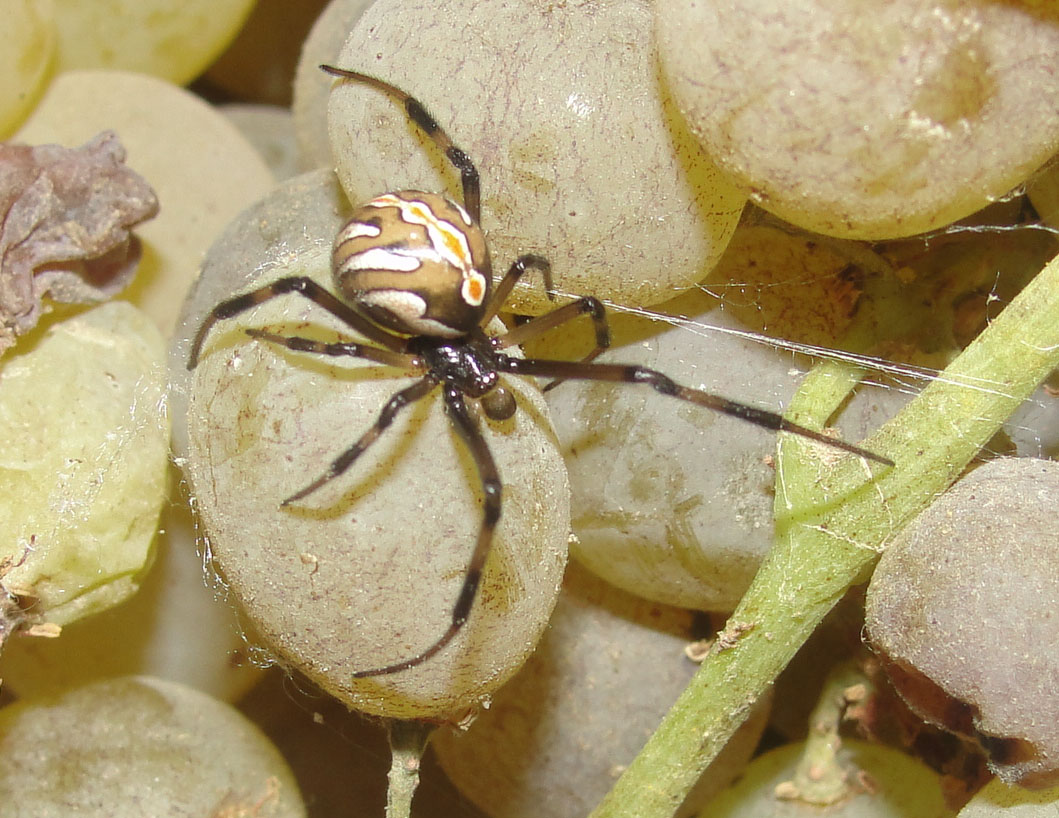
Latrodectus geometricus

It's grape harvesting time in the Central Valley - actually, it's just coming to an end. It's a couple of weeks behind schedule because of the cooler and wetter spring but the bugs have eventually caught up with the season. Last week while going through several bunches of grapes, a colleague of mine stumbled onto this attractive relative of the black widow spider - the brown widow, Latrodectus geometricus.


This spider is not known for its nasty bight, although it can and, if provoked, will. What is striking is the pretty pattern on its back. It is actually not originally from the US. Having come from Africa some time ago, it seems to prefer the subtropical regions of the US - particularly Southern California. One message from all of this: maybe wear gloves if your in the vineyard.


Saturday, September 24, 2011

Pseudanostirus pudicus

Here's a click beetle that tends to fairly local in the Rocky Mountains. It can be common in Utah but it is often poorly represented in collections outside the area. It looks similar to the more widespread P. propola but lacks the bold elytral markings. They tend to be more diffuse in P. pudicus.


I found this one at about 6,000 feet up American Fork Canyon (Utah County, Utah) a month ago just as the sun was setting. It was resting on stream-side vegetataion when I discovered it.  I've seen it at elevations as high as 8,000 - 9,000 feet.